


How to Increase Google Restaurant Reviews for Growth in 2026

.png)
Stop losing guests to AI. Watch the exclusive session to audit your visibility and outrank every local competitor.
Google reviews are the closest thing restaurants have to a front-of-house team working 24/7 online. Before a guest ever sees your menu or walks through your door, they've already looked you up — and what they find determines whether you make the shortlist or get skipped entirely.
This guide breaks down exactly why reviews drive revenue, what the data says about ratings and customer behavior in 2026, and 10 proven tactics to increase your Google restaurant reviews at scale — whether you operate 3 locations or 300.
Why Google reviews matter for restaurants in 2026
Over 90% of diners read online reviews before choosing where to eat, according to multiple consumer research studies. And 81% use Google as their primary platform to do it. That's not just a majority — it's near-total market saturation.
If your Google presence is weak, you're invisible to the overwhelming majority of potential guests before the dining decision is ever made.
The trust signal is equally striking. According to BrightLocal's Consumer Review Survey, 91% of Americans trust online reviews as much as personal recommendations from friends and family. For a restaurant, a strong Google profile with fresh, high-volume reviews effectively functions as word-of-mouth marketing at scale.
Then there's the rating floor. Research consistently shows that 33% of diners won't eat at a restaurant with less than a 4-star rating.
And 84% say they're more likely to trust a business that has a high volume of recent reviews — meaning a 4.8 rating from three years ago carries far less weight than a 4.4 with 40 reviews from the past 90 days.
⭐ Check out our Ultimate Guide to Restaurant Review Management in 2026.
Restaurant Groups Reviews: Key benchmarks to track
Knowing how many reviews to increase rating and improve rankings means setting concrete targets, not vague goals. Here are the benchmarks that matter in 2026:
Location-level tracking is non-negotiable for groups. A group average obscures underperforming locations — and those underperformers are the ones costing you the most in lost foot traffic and search visibility.
Why increasing Google reviews = more revenue for restaurants
The revenue impact of review ratings is measurable and significant.
A Harvard Business School study by Professor Michael Luca found that a one-star increase in a restaurant's average rating leads to a 5–9% increase in revenue.
That number, while originally modeled on Yelp, has been widely replicated across review platforms including Google.
Black Box Intelligence went further, analyzing sales data across thousands of restaurant locations to calculate the exact dollar value of Average Star Rating (ASR) improvement.
Their findings show that a 1.0-star increase for a fine dining restaurant drives over $222,000 in additional annual revenue per location.
For a restaurant group with 10 or 25 locations, the compounding effect becomes transformative.
Beyond revenue, businesses that actively respond to reviews see 35% more revenue than those that don't, according to MagicReply's analysis of review response data. Customers who read responses before visiting also tend to spend 31% more on average, per research cited by Virtual College.
Positive Google reviews are also directly linked to up to 18% revenue growth in conversion-focused studies (SocialPilot). The ROI of a systematic review strategy is not incremental — it's one of the highest-return marketing activities a restaurant operator can invest time in.
The local SEO and AI discovery angle
Google's local search algorithm weighs three core review signals: quantity, quality (average star rating), and velocity (the rate at which new reviews are coming in). Restaurants that generate 3–5 new reviews per week tend to rank meaningfully higher in Google Maps and local search results than competitors with similar ratings but stagnant review profiles.
Recency matters as much as volume. A 2025 study by EmbedSocial found that businesses with 50+ reviews and a 4.5+ star rating see up to 30% better visibility in local search rankings.
Reviews contribute approximately 10% to total local ranking factors, according to LocaliQ — and appearing in Google's local 3-Pack generates roughly 126% more traffic and 93% more conversions compared to positions below it.
In 2026, this also applies to AI-generated discovery. Google's AI Overviews and tools like ChatGPT and Perplexity increasingly surface local restaurant recommendations based on review signals. High volumes of recent reviews with specific, keyword-rich content (mentions of menu items, neighborhood, occasion types) directly increase the probability that your restaurant appears in AI-generated answers to queries like "best Italian in [neighborhood]" or "where to take a date in [city]."
For multi-location groups, this means the local SEO strategy at each individual location must generate its own steady stream of reviews — a consolidated group-level rating does nothing for individual store discoverability.
The visibility gap problem for restaurant groups
This is where multi-location operators face a challenge that single-location restaurants don't. Each of your locations needs its own review engine. A corporate rating or a flagship location's stellar reputation doesn't transfer to a location that opened six months ago, or one in a market where you're less established.
Without a systematic approach, review volume naturally concentrates at your most popular or longest-operating locations while newer or quieter ones get left behind — creating visibility gaps that cost you real foot traffic and revenue. Restaurant groups using decentralized management (each location handles its own outreach or nothing happens at all) compound this problem over time.
The solution is a centralized, repeatable system that runs consistently at every location simultaneously. That's the core premise behind the 10 tactics below.
10 proven tactics to increase Google restaurant reviews in 2026
1. Ask at the peak of satisfaction — every single time
The moment a guest pays, compliments the meal, or sends a positive message is the highest-probability window for a review. Most restaurants let these moments pass. Training front-of-house staff to make a specific, direct ask — "Would you mind leaving us a quick Google review? It takes 30 seconds and helps us a lot" — with a QR code or direct link handed over immediately is the single highest-ROI action you can take. Done consistently across all locations, it builds volume faster than any digital campaign.
KPI: Track the number of weekly in-person review requests per location. Target: 20–30 requests per location per week.
2. Deploy QR codes or Booster at every physical touchpoint
A QR code that links directly to your Google review form eliminates all friction. Place them on:
- Table cards and receipt slips
- At the host stand and near the exit
- On to-go bags and delivery packaging
- On bathroom mirror clings (highly effective for casual dining)
Each QR code should link to your location-specific Google Business Profile review URL — not a generic homepage.
For groups, generate a unique QR code per location and track scan-to-review conversion rates separately. Your best option: using Malou's Boosters specifically designed for groups.
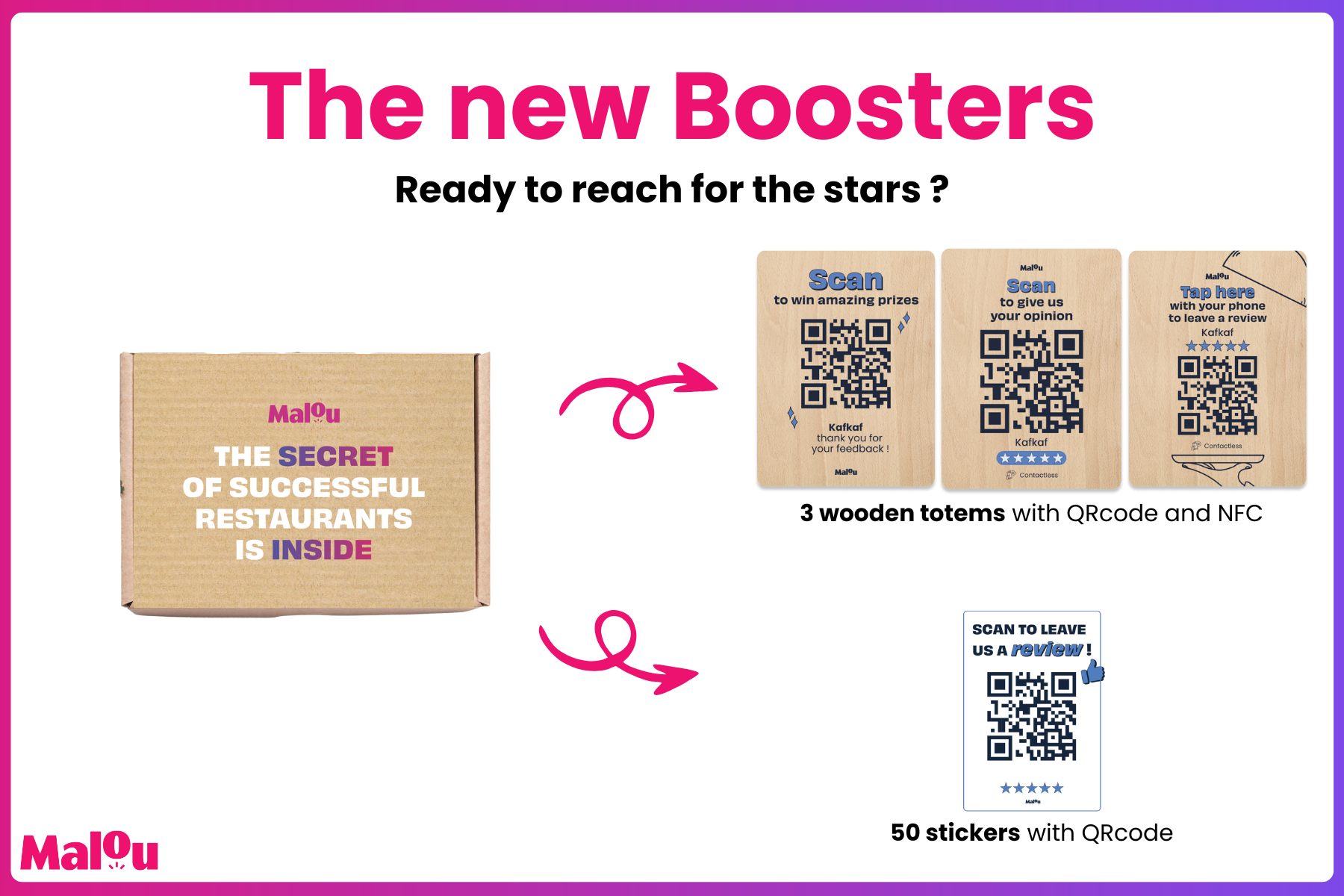
KPI: QR code scans per location per week. Target: 15+ scans converting to reviews.
3. Send a post-visit SMS within 2 hours or follow-up by email
Timing is everything. SMS review requests sent within 2 hours of a visit (or after a delivery order is completed) consistently outperform those sent the next day. Keep the message short, personal, and direct:
"Hi [Name], thanks for dining with us tonight! If you enjoyed your experience, a quick Google review would mean the world to our team: [direct link]. Takes 30 seconds!"
SMS open rates average 98% versus 20% for email, making it the most reliable digital channel for post-visit review requests.
KPI: SMS review request conversion rate per location. Target: 8–12% of recipients leaving a review.
For guests who booked via reservation system or ordered delivery, a follow-up email 24 hours later captures the segment that didn't respond to SMS. The subject line matters: "How was your meal?" consistently outperforms "Please leave us a review." Include the direct Google review link above the fold — don't make guests scroll to find it.
KPI: Email review request open rate and click-through rate. Target: 25% open rate, 15% click-to-review.
4. Optimize your Google Business Profile at every location
Review volume alone doesn't maximize your ranking potential on Google.
Each location's Google Business Profile needs to be fully and accurately completed — correct hours (including holiday hours), current photos, menu information, and active Q&A responses. Google rewards complete, regularly-updated profiles with higher baseline visibility, which in turn drives more organic reviews from guests who discover you through search.
For groups managing 10+ locations, this is where a platform like the MalouApp delivers immediate operational value: presence updates pushed simultaneously across all locations from one dashboard, rather than logging into each GBP individually.
KPI: GBP completeness score per location. Target: 100% profile completeness across all locations using the MalouApp.
5. Respond to every review — positive and negative
Responding to reviews signals to Google that your business is active and engaged, which feeds ranking algorithms directly. It also influences prospective guests: a study cited by ReplyOnTheFly found that businesses responding to reviews see up to 18% revenue increase, and that response rate is now a visible metric in some Google profiles.
Here's our guide on how to handle negative reviews to increase your visibility.
For positive reviews, a 2–3 sentence personalized response that references something specific in the review performs far better than a generic "Thank you!" For negative reviews, a calm, ownership-taking response that offers a resolution converts a potential deterrent into a trust signal for readers.
KPI: Review response rate per location. Target: 100% response rate within 24–48 hours.
6. Embed reviews on your website with a Store Locator
Sharing your best Google reviews as Instagram posts, Stories, or on your website's homepage with a Store Locator creates a feedback loop.
Happy guests who see their own reviews featured are more likely to leave future reviews, and prospects who see the social proof are primed to visit and then contribute reviews of their own.
User-generated content featuring a specific dish or experience also generates keyword-rich reviews organically over time, which is key for AI Discoverability or "GEO"(visibility on ChatGPT).
KPI: Monitor organic review mentions of specific menu items using semantical analysis.
7. Train every location's team — consistently
For restaurant groups, review velocity often collapses when staff turnover happens or when the initial push fades after the first few months. Building a review request into the service checklist (the same way you'd standardize a farewell greeting or an upsell script) protects against this. Run a quarterly review training refresh and share location-level leaderboards so each team sees how their review numbers compare to sister locations.
KPI: Review count per location month-over-month. Target: minimum 10–15% month-over-month growth for locations below 100 reviews.
8. Write keyword-rich review responses (and prompt keyword-rich reviews)
This is an underutilized local SEO lever. When you respond to reviews, include natural mentions of your location, cuisine type, or signature dishes: "So glad you enjoyed our wood-fired pizza in [neighborhood]!" These responses are indexed by Google and contribute to the semantic relevance of your profile for location-based searches.
On the prompt side, when asking for reviews in person or via SMS, you can gently guide the content: "If you loved the lamb chops, feel free to mention that — it helps others know what to order!" This generates reviews that naturally contain the keywords your location wants to rank for.
KPI: Track ranking improvements for target keyword phrases month-over-month after implementing keyword-guided review responses.
9. Use AI-powered tools to systematize review management at scale
For a single-location operator, manually requesting and responding to reviews is manageable. For a group with 5, 20, or 100 locations, it becomes impossible without automation. This is the exact problem that platforms like the MalouApp are built to solve.
Malou's centralized reputation management lets you monitor all incoming reviews across every location in real time, respond with AI-generated responses tailored to each location's voice and the specifics of each review, and track review velocity and rating trends per location from a single dashboard. Restaurant groups using Malou report saving an average of 28 hours per month on marketing operations — time that teams reinvest into higher-value activities. The AI-powered response suggestions maintain authenticity at each location while eliminating the bottleneck of writing individual responses manually.
10. Use the best reputation management tools for restaurant groups
For restaurant reputation management at scale, automation isn't optional — you need a restaurant review app. It's what separates groups that maintain consistent review velocity across all locations from those that rely on sporadic, location-by-location efforts.
KPI: Average time to review response across all locations. Target: under 48 hours at 100% response rate.
The ROI of getting this right
A restaurant group with 10 locations, each currently averaging 3.8 stars, that executes this playbook and moves to 4.3 stars across the board is looking at a revenue impact in the range of hundreds of thousands of dollars annually — based on Black Box Intelligence's data showing that a 1.0-star improvement across 10 locations drives over $500,000 in additional revenue. Even a 0.5-star lift at each location moves the needle materially.
More immediately, the local SEO gains compound: more reviews drive higher rankings, higher rankings drive more organic discovery, more discovery drives more guests, more guests generate more reviews. The flywheel, once set in motion, is self-reinforcing.
For restaurant groups looking to strengthen their overall SEO, a systematic review strategy is the single fastest-return tactic available — one that pays dividends in organic traffic, conversion rates, and in-store revenue simultaneously.
Interested? Feel free to call us at +1 (929) 483 0848 or book a demo here.

We put The double bites to satisfy you
Increase your visibility on Google and social networks with Malou.
