

The Best Restaurant Reputation Management Tools in 2026: The Multi-Unit ROI Guide

.png)
Stop losing guests to AI. Watch the exclusive session to audit your visibility and outrank every local competitor.
In the "Agentic AI" era of 2026, a restaurant's reputation is no longer just a collection of stars—it is the primary data fuel for growth and discovery.
With 90% of diners choosing their next meal based on online reviews and 86% of younger adults trusting AI-generated review summaries, your online sentiment is your most valuable financial asset.
For multi-unit hospitality groups, managing this at scale is the difference between a 3% margin and a 12% margin.
A 1-star increase on platforms like Yelp or Google translates directly to a 5% to 9% increase in revenue.
However, in 2026, "managing" e-reputation means more than just replying to comments; it means leveraging Google reviews for Local SEO and Generative Engine Optimization (GEO) to ensure Discoverability on AI: that search engines like ChatGPT and Google Gemini will recommend your locations.
This guide compares the leading review collection and reputation management platforms for restaurant groups in 2026 — covering automation channels, POS and CRM integration depth, Google's policy guardrails, and a decision checklist to help executives pick the right stack for their scale.
Top Reputation Tool: Best picks by use case
Why Your Reputation Tool is Now an Operational KPI
Leading restaurant groups have stopped treating reviews as "feedback" and started treating them as Predictive KPIs.
With semantic analysis, the MalouApp can instantly detect any operational problem that may occur in one of your locations.
Negative and positive reviews are datas and can be predicted.
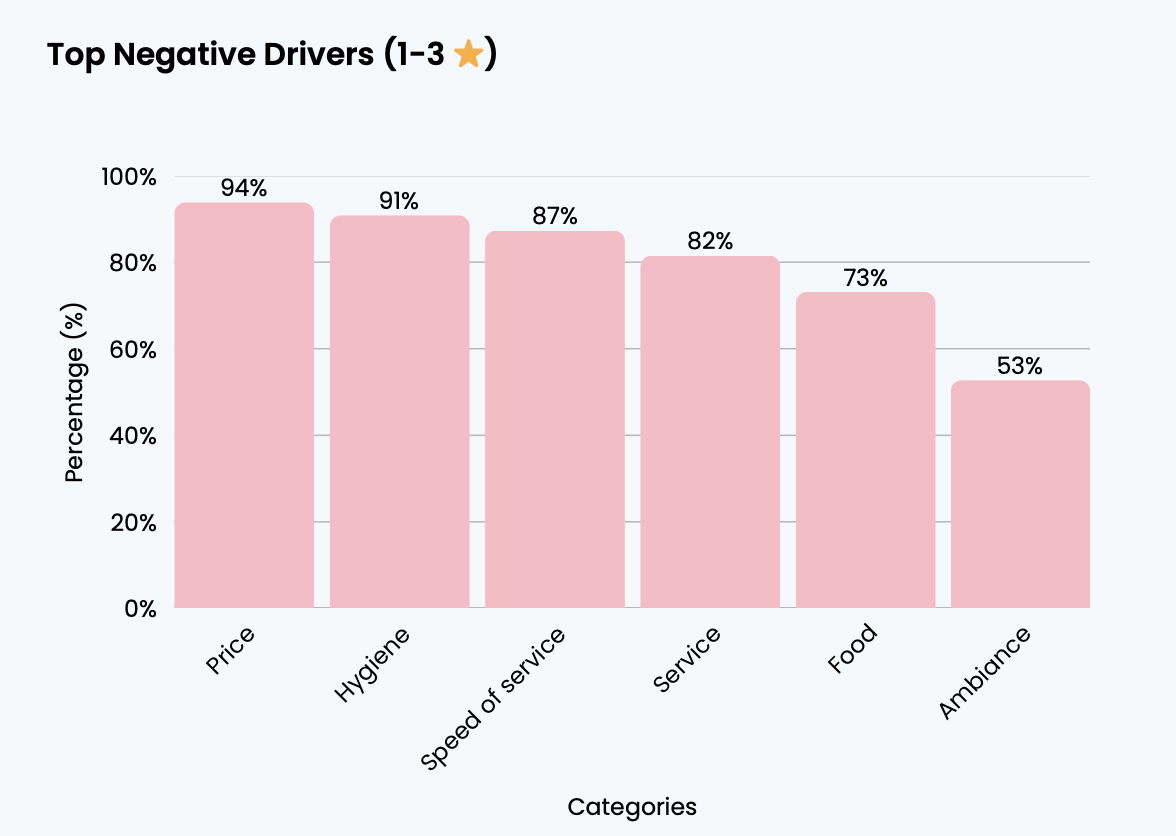
By 2025, 86% of US restaurant operators were using AI weekly to analyze these signals.
The 3 main reasons your group need a reputation tool and an e-reputation strategy:
- Visibility Power: Review volume and recency are top-3 ranking signals for Google Maps and AI Overviews.
- Operational Intelligence: Semantic analysis identifies "irritants"—recurring mentions of price, hygiene, or service—allowing for site-by-site corrections before ratings drop.
- Conversion Efficiency: 14% of US consumers will not consider a restaurant rated below 4 stars. Moving from a 3.9 to a 4.5 rating is the "psychological trust threshold" for high-volume conversion.
The ROI of Reputation Automation for Restaurant Groups
Beyond the Harvard 5–9% revenue figure, the mechanism is specific to how Google ranks local businesses. Google's local pack algorithm weighs review recency, volume, and keyword content within review text.
A chain that consistently generates new reviews across all locations gains a compounding local search advantage over one that collects reviews sporadically.
According to a 2026 Shapo analysis of online review data, 65% of customers are influenced by online reviews when choosing a restaurant. A single location at 3.9 stars loses diners to a competitor at 4.3 stars even when they rank in the same local pack.
Multiply that across 15 or 30 locations and the revenue impact becomes a board-level conversation.
Moreover, our latest study shows that restaurant chains experiment a 1.3 review gap* among their locations.
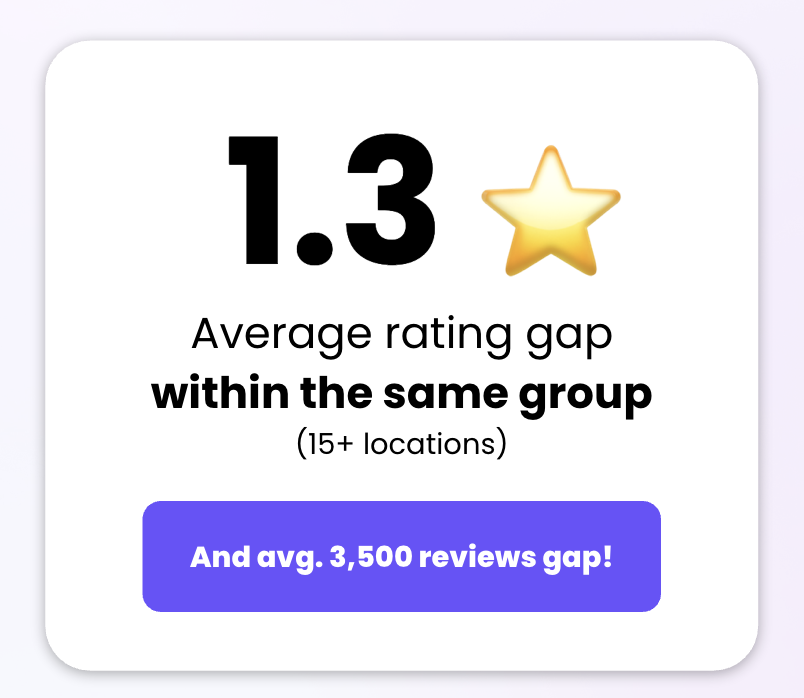
For multi-location groups, there are three compounding failure modes when review collection goes unmanaged:
- Rating variance — one 3.1-star unit drags brand perception across the entire concept.
- Response lag — Google favors businesses with recent, active responses; unanswered reviews signal poor operations.
- Unrecovered dark feedback — guests who would have left 3 stars post publicly instead of privately when no prompt redirects them.
Automating collection at the point of experience closes the feedback loop before guests cool off, while routing dissatisfied guests to a private channel before they post publicly.
Groups that want to quantify their current gaps before committing can use Malou's free online diagnostic, which audits review volume, response rate, rating trajectory, and local search visibility per location.
Top Restaurant Reputation Management Tools: 2026 Buyer's List
For a restaurant chain, the ideal tool must centralize execution while providing granular, location-level insights. Here are the top platforms to consider.
1. Malou: The #1 AI-Powered Reputation & GEO Ecosystem
Website: malou.io

Malou is the first all-in-one ecosystem engineered specifically for multi-location hospitality groups to turn reputation into revenue. It acts as a digital "command center" that synchronizes reputation, SEO, and social media into one growth engine.
Malou is the only platform on this list purpose-built for multi-location restaurant groups that combines review collection automation with presence management, local SEO, AI-powered response generation, and cross-location analytics in a single dashboard.
For a group with 10+ locations, the operational difference is immediate. Instead of logging into separate Google Business Profile accounts, TripAdvisor dashboards, and a standalone review tool, the marketing team sees every inbound review across every location in one unified inbox. AI-generated response suggestions adapt to each location's identity — a meaningful distinction when your group operates both a brasserie concept and a fast-casual burger chain.
Malou maintains connections to 50+ discovery and social platforms including Google, Facebook, Instagram, TripAdvisor, and Uber Eats. Location-specific QR codes route guests directly to the Google Business Profile review form, bypassing extra steps that reduce conversion.
- Hospitality-Trained AI: Unlike generic tools, Malou uses AI trained exclusively on restaurant data to generate automated, on-brand responses that handle 100% of reviews in minutes, not hours.
- Predictive Semantic Analysis: Malou’s engine automatically detects "risky topics" (e.g., hygiene lapses or price inconsistencies) across 250,000+ reviews, alerting District Managers to operational gaps in real-time.
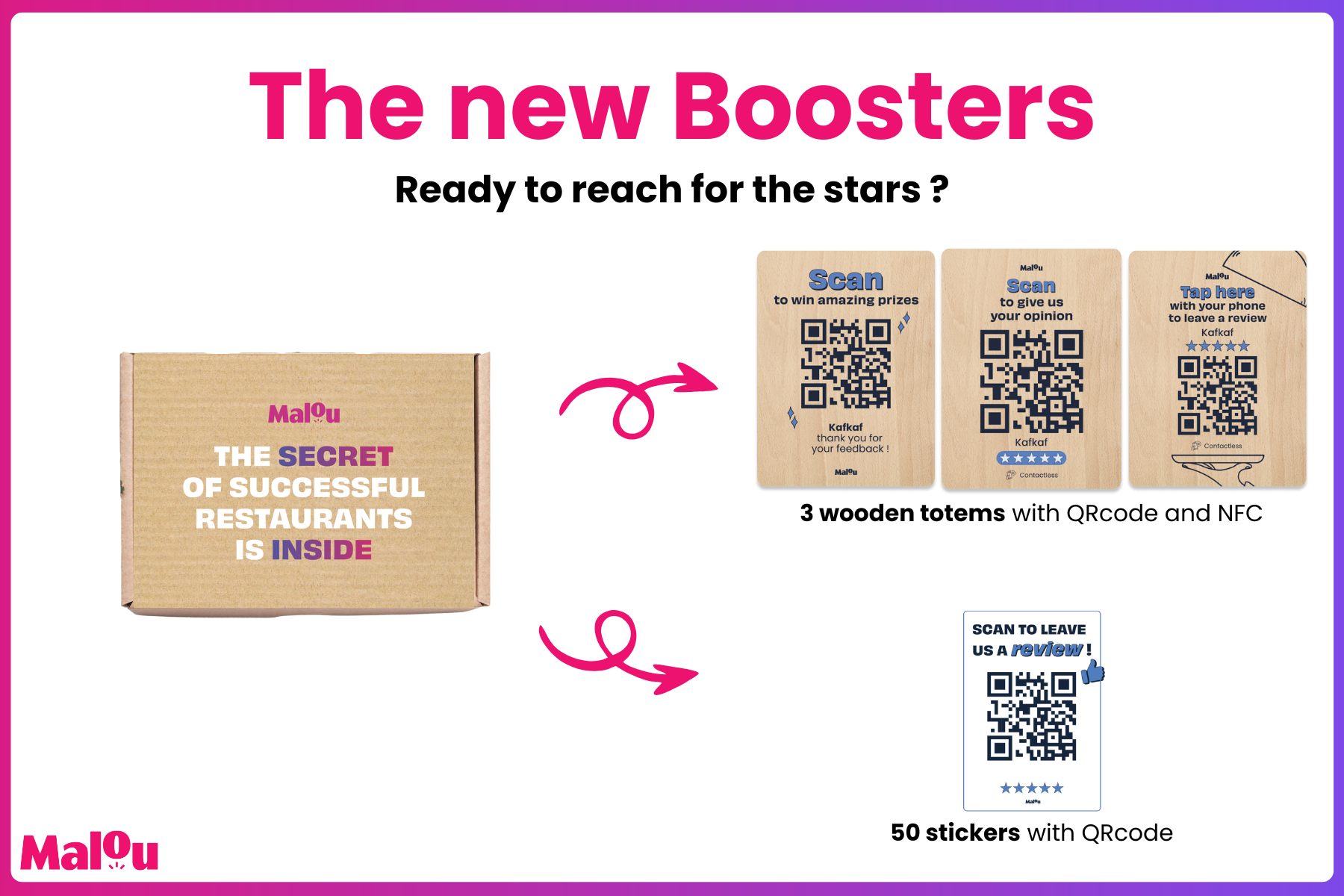
- The "Review Booster" Engine: Utilize physical NFC Totems and gamified QR codes with a "Wheel of Fortune" to increase review volume by 5x.
- The GEO Magnet: Malou pushes your data to 60+ platforms (including OpenAI), ensuring that ChatGPT and Perplexity have the "consensus of data" required to recommend your brand.
- The ROI Factor: Malou users save 28 hours per month per location and see an average +15% score progression within 12 months.
Malou's reported outcomes across its 2,000+ restaurant network: +18% more customers per month on average, 350%+ reach growth online, and 28 hours saved per month in manual marketing work.
The Malou resource library also includes a dedicated e-reputation benchmark report with aggregated data on positive and negative review performance across the hospitality sector — useful for building an internal business case.
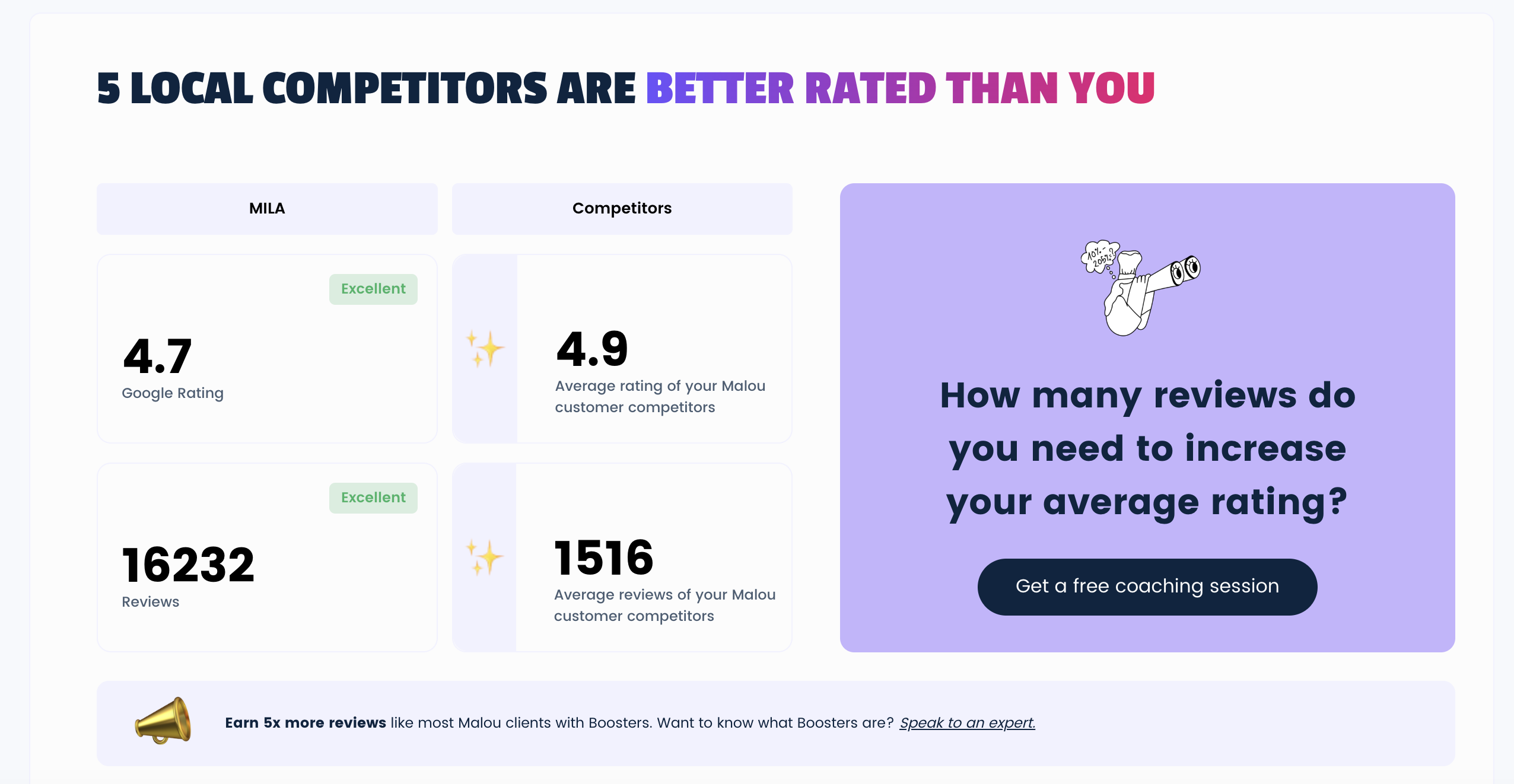
1.B. Bonus Tool: The Online Google Review Calculator
This free marketing tool was developed by Malou's Data Analysts team based on +3 000 locations in hospitality.
Based on your locations' current ratings, this tool will let you know how many reviews you need to collect to get an extra +1 star on you Google Business Profile.
2. Birdeye: Best for Generalist Enterprise — cost compounds at scale
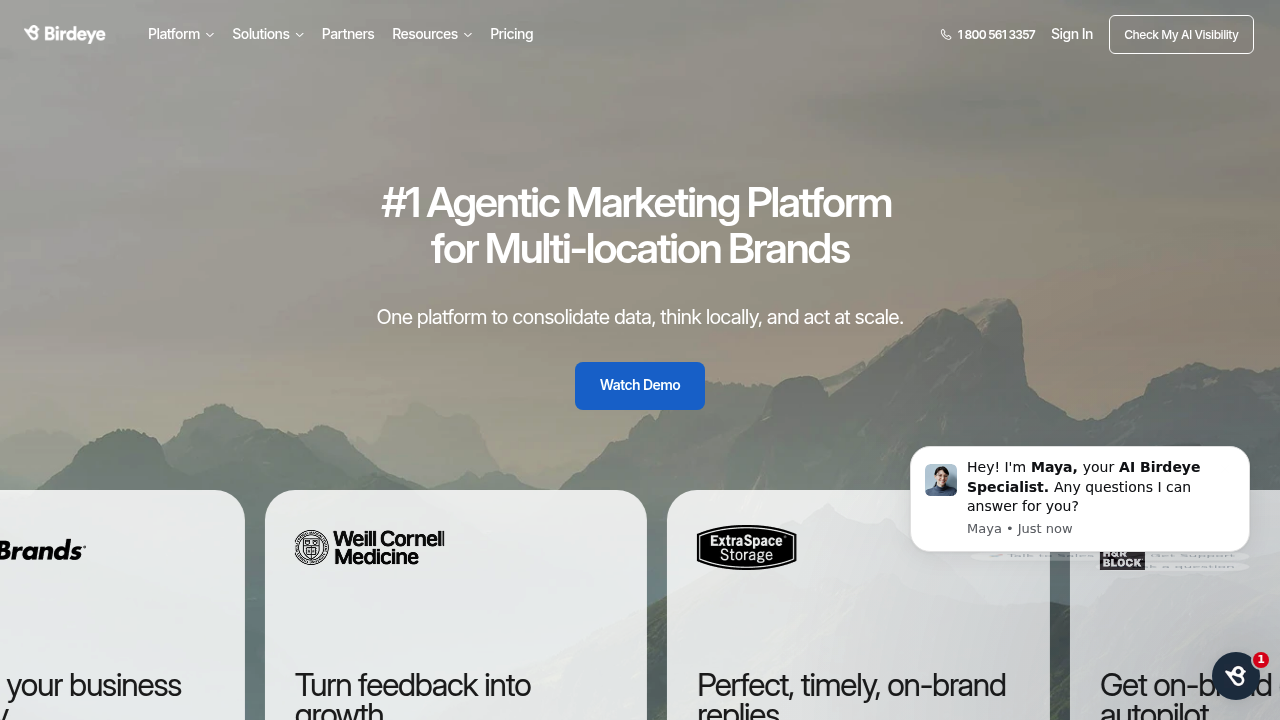
Birdeye remains a heavyweight for massive chains (hundreds of locations) but is not hospitality-specific. It offers the most robust "set-and-forget" automation.
Birdeye collects reviews via SMS, email, QR, and in-app channels with connections to 200+ platforms. Its AI response drafting and sentiment analysis are solid at the SMB level.
The cost model is the constraint for chains: at $299–$449/location/month, a 15-location group pays $4,500–$6,750/month before enterprise negotiation. Groups above 10 units typically find per-location pricing hard to justify against group-rate alternatives.
- Key Feature: Massive integration library (200+ sources) and "BirdAI," which identifies sentiment trends across different regions.
- Best For: Enterprise-level operations that need deep data bench-marking and complex corporate-to-local permission settings.
3. Podium — SMS-native, limited chain depth
Podium's strength is SMS-based review requests — a text post-transaction that routes to Google or Facebook review forms. It performs well for single locations or small groups with owner-operators running closely.
At ~$399/location/month, with POS connectivity relying on third-party middleware and limited central reporting, it's a better fit for owner-operators than for marketing teams managing 10+ units from a central dashboard.
4. Chatmeter — enterprise local SEO combined with reputation
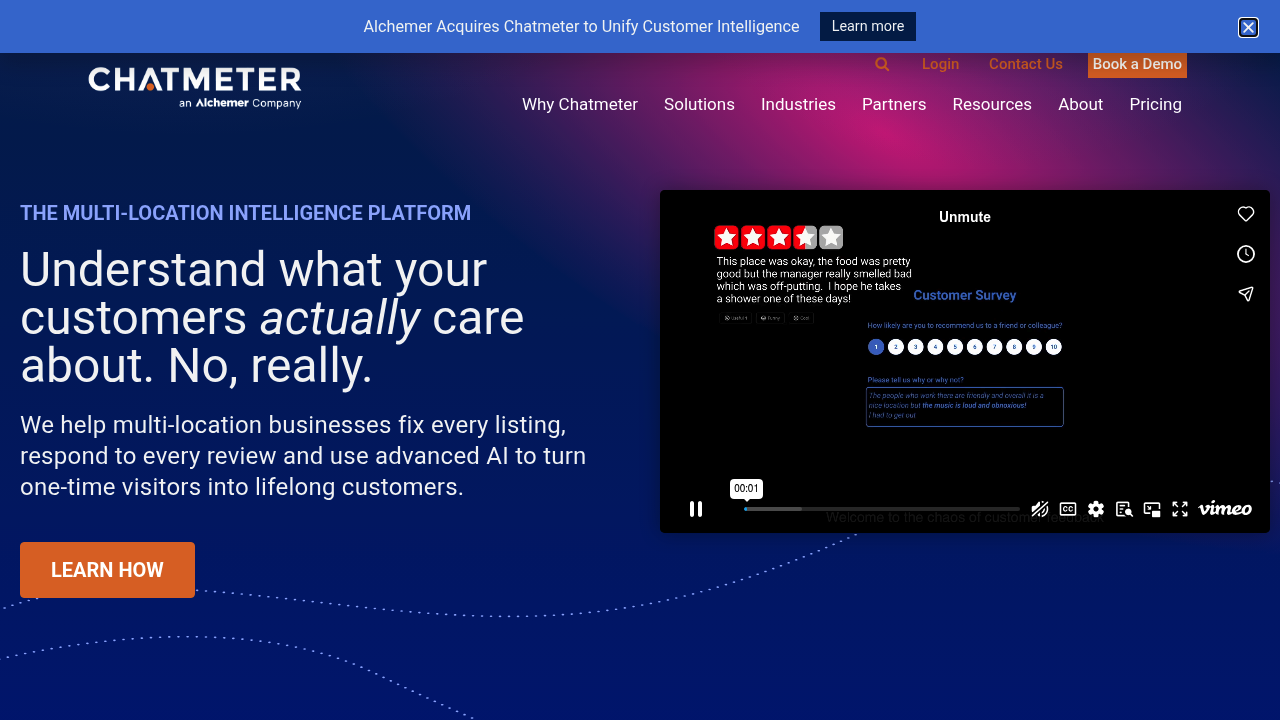
Chatmeter targets enterprise restaurant and retail chains with combined local SEO and review management. Listing management, review aggregation, and local analytics are competitive at the enterprise tier.
The platform doesn't include social media content creation or AI post generation, so groups typically need additional tooling alongside it.
Choosing a Reputation Management Tool: Our Tips for 2026 Reputation Mastery
3 Expert tips all Restaurant Groups Should Know
- Close the "Operational Loop": Don't just reply to a "cold food" review. Use semantic analysis to track if "cold food" is a recurring theme at Location A. If it is, the problem isn't marketing—it's the kitchen.
- Incentivize Volume, Not Just Stars: AI engines value a restaurant with 2,000 reviews and a 4.4 rating over one with 50 reviews and a 5.0. High volume proves "data legitimacy".
- Fight "Data Inconsistency": If your closing hours or address differ between Yelp, Google, and your website, AI engines will demote your visibility due to lack of trust. Use a centralized sync tool like Malou to ensure 100% consistency in one click.
6-question decision checklist
Use these questions to filter platforms against your specific requirements:
- How many locations do you manage? Under 5: per-location pricing (Birdeye, Podium) may be viable. Above 10: prioritize group-pricing platforms with centralized admin.
- Do you have reservation or loyalty data? If yes, email-triggered review requests via your existing system are the highest-ROI starting point.
- What's your primary review platform? Google dominates local search; confirm any tool you deploy has a direct Google Business Profile integration.
- Do you need social and presence management alongside reputation? If yes, a dedicated marketing platform (Malou) avoids the cost and friction of maintaining separate tools.
- What's your response SLA? If you need sub-24-hour response across all locations with minimal headcount, AI-generated response drafts are non-negotiable.
- Are you operating internationally? Verify platform support for regional review platforms (TripAdvisor in Europe, local equivalents in APAC) and multi-language response generation.
Automation channels: which format fits your service model
Each channel has different conversion rates and fits different dining formats:
- QR codes on receipts or table cards or Malou's Boosters — highest adoption in full-service restaurants. Placed on the check presenter, they require no staff action post-setup. Malou generates location-specific QR codes that route directly to the Google review form.
- Email post-visit — works well for groups with reservation systems (OpenTable, SevenRooms) or loyalty programs capturing email addresses. Typically sent 2–4 hours after the reservation close.
- SMS — 98% open rates but subject to TCPA opt-in requirements in the US and carrier filtering. Podium is the strongest native SMS platform.
- In-app / loyalty integration — relevant for chains running loyalty apps; review prompts appear within the post-redemption flow.
- On-receipt / printed QR — works offline, requires no data capture, GDPR/CCPA neutral. Best for fast-casual and QSR formats.
For most multi-location full-service groups, QR-on-receipt combined with email via reservation system generates 3–5x more reviews per month than unautomated collection.
Integrations technical checklist
Before purchasing, verify these integration points against your tech stack:
- AI built for hospitality — Is the tool AI-fueled and if yes, is it specific to restaurant groups? Especially for review automation: you need an AI tool tailor-made for restaurants.
- POS system — Does the platform receive transaction-close signals to trigger review requests? Native connectors (Toast, Square, Lightspeed) eliminate middleware dependency.
- Reservation system — OpenTable, SevenRooms, and Resy integrations enable post-visit email triggers with guest name personalization, improving review conversion.
- Loyalty / CRM — Review prompts embedded in post-visit reward emails consistently outperform cold review requests. Confirm connectivity to your CRM or loyalty platform.
- Multi-location admin controls — Can corporate set response templates and brand tone while location managers operate within those guardrails?
- API access — For groups building BI pipelines, verify REST API availability to pull review data into tools like Tableau or Looker.
Google's review policy — what compliance looks like in practice
Google's review guidelines explicitly prohibit incentivizing reviews. According to a January 2026 report from DAC Group, Google has increased enforcement on incentivized review schemes, with businesses risking removal of affected reviews and suspension of Google Business Profiles.
What's permitted under current Google policy:
- Asking guests to leave a review in-person, via QR, or via email/SMS post-visit
- Providing a direct link to the Google review form
- Responding to reviews publicly
- Manage negative reviews to leverage growth
- Routing dissatisfied guests to a private feedback form before they post publicly — as long as positive reviewers aren't selectively funneled to public platforms while negative ones are systematically excluded
The last point is where some platforms' "negative review gating" features create compliance risk. Verify that any tool you deploy routes all guests through the same initial feedback path.
Benchmark metrics to expect after deployment
Based on aggregated outcomes across restaurant groups using automated review collection:
- Review volume: 3–5x increase in monthly review count within 60–90 days of deployment
- Response rate: Groups using AI-assisted response tools typically reach 90%+ response rates vs. industry averages below 50%
- Rating improvement: Groups that respond to all reviews and address recurring negative feedback themes see average rating improvements of 0.3–0.5 stars over 6 months
- Local search visibility: Consistent review velocity correlates with improved local pack rankings, particularly for branded and near-me queries
Malou's internal data across its restaurant network shows groups achieving +18% more customers per month on average — driven in part by improved local search rankings from stronger review profiles.
Conclusion: Reputation is Your Growth Infrastructure
In the competitive US landscape, scaling a restaurant group demands more than great food; it requires digital visibility and data consistency. Monitoring your data prevents a "bad day" from turning into a "bad month".
For restaurant groups with 3+ locations, the starting point should be a location-by-location audit of current review volume, response rate, and rating by location — that data reveals exactly where revenue is leaking and which locations need the most immediate attention.
Ready to see how your reputation impacts your bottom line?
Discover now your Free AI Visibility Audit or call a Malou expert at +1 (929) 483 0848.
Let’s turn your reviews into your most powerful acquisition channel.


We put The double bites to satisfy you
Increase your visibility on Google and social networks with Malou.
