


The Ultimate Guide to Restaurant Review Management in 2026

.png)
Stop losing guests to AI. Watch the exclusive session to audit your visibility and outrank every local competitor.
95% of diners in the US say online reviews influence which restaurant they choose, according to Small Business Trends. The number isn't surprising — but what's changed dramatically is how those reviews now shape your business beyond just e-reputation.
In 2026, reviews are a local SEO signal, a ranking factor in AI-generated answers (GEO), a source of operational intelligence, and a direct driver of revenue.
A Harvard Business School study by Michael Luca found that a single-star increase drives a 5–9% jump in restaurant revenue.
Review signals now account for roughly 15% of local SEO ranking factors, according to Shapo's 2025 Google review analysis. And with AI Discovery tools like ChatGPT and Google's AI Overviews surfacing restaurant recommendations from user-generated content, the volume and quality of your reviews have never mattered more.
For restaurant groups managing 5, 20, or 100+ locations, the challenge isn't understanding why reviews matter — it's building the systems to manage them at scale.
This guide covers everything: the business case, platform-by-platform tactics, how to respond effectively, which tools actually work, and what separates groups that win local discovery from those that don't.
Make sure you also read our full guide dedicated to Google Reviews for Restaurants.
Why Restaurant Review Management is a Growth Leverage for Groups
Google Business Profile (GBP) is the first thing a potential customer sees when searching for your restaurant online. Google reviews have massive influence when it comes to bringing clients in.
What's shifted in 2026 is the breadth of impact. Reviews now influence 4 separate performance levers simultaneously:
Local SEO rankings
Google's local ranking algorithm treats reviews as a trust signal — specifically the quantity, recency, rating, and relevance of keywords in review text. According to Shapo's 2025 data, review signals make up approximately 15.44% of local SEO factors.
Photo-rich, keyword-specific reviews can meaningfully lift a location's position in Google Maps and the Local Pack. For groups, this compounds: a chain with 50 locations, each generating consistent reviews, builds a significantly stronger local search footprint than a competitor who manages reviews reactively. That's why using any review app for restaurants, of better, a reputation management tool is absolutely key for restaurant chains.
Generative Engine Optimization (GEO)
This is the new frontier. AI search engines — ChatGPT, Perplexity, Google Gemini — are increasingly the first destination for "best restaurant near me" queries. McKinsey's October 2025 analysis found that half of all consumers now use AI-powered search.
These systems heavily favor businesses with large volumes of authentic, recent user-generated content. Reviews are exactly that content. A restaurant with 800 genuine reviews containing specific dish names, neighborhood references, and experiential detail is far more likely to appear in an AI-generated recommendation than one with 80 generic four-star ratings.
For a deeper look at how AI search is reshaping restaurant discovery, see AI Discoverability for Restaurants: The 2026 GEO Checklist.
Operational intelligence with Review Semantics
At scale, reviews are data. The most profitable franchises know it: treating Google reviews like insights and data is the best way to scale and improve your network.
Semantic analysis of review text reveals which menu items generate complaints, which locations underperform on wait times, and which staff members consistently get named in five-star feedback.
Semantic analysis will also allow you to identify the top negative or positive drivers for your restaurants.
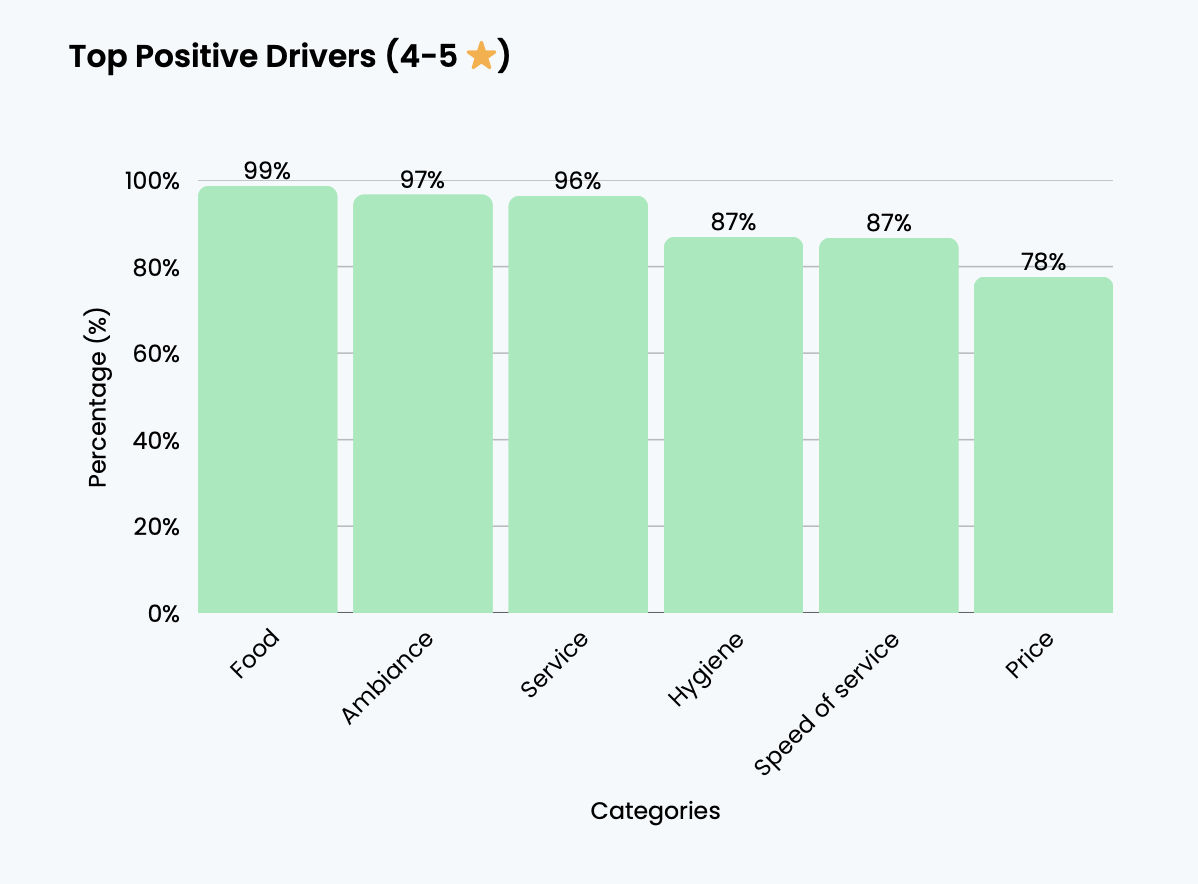
Groups using AI-powered tools for restaurant reviews like the MalouApp can extract these insights automatically, turning guest feedback into actionable operational decisions.
Revenue & Growth
Analyzing sales data across thousands of restaurant locations, Black Box Intelligence calculated the exact dollar value of Average Star Rating (ASR) improvement.
Their study show that a 1.0-star increase for a fine dining restaurant drives over $222,000 in additional annual revenue per location.
The financial case for review management is no longer theoretical.
For restaurant groups, this is even more critical as reviews are multiplied by 5, 10 or 100.
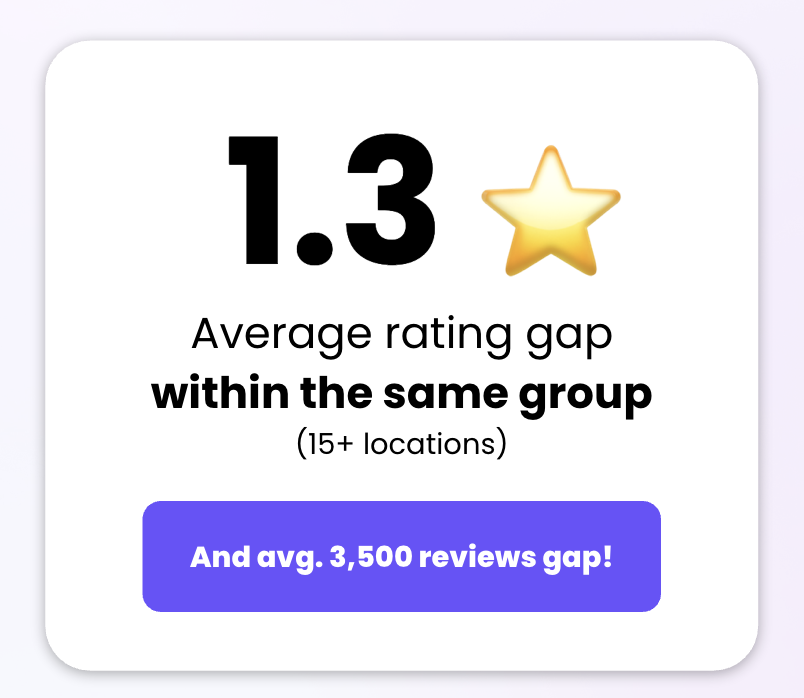
Malou's latest study shows that restaurant groups experiment a 1.3 review gap* among their locations.
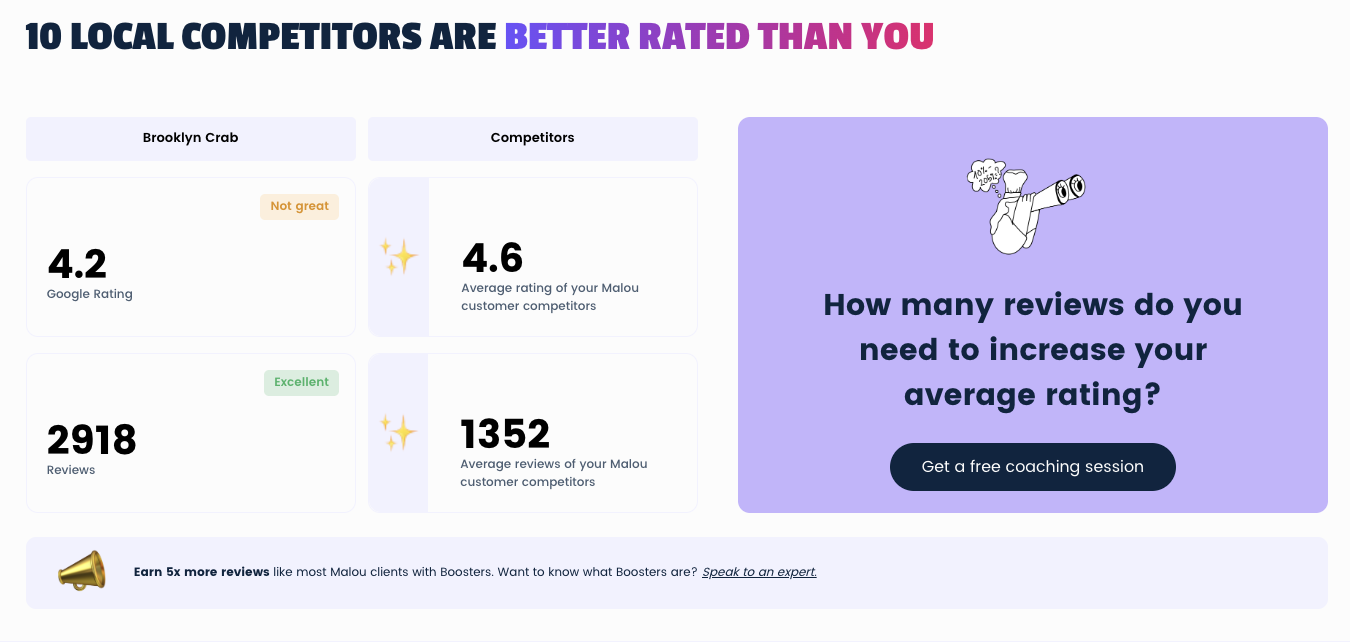
Groups that want to quantify their current gaps before committing can use Malou's free online diagnostic, which audits review volume, response rate, rating trajectory, and local search visibility per location 👇
Which platforms matter most for restaurants in 2026
Not all review platforms carry equal weight. Prioritizing them correctly is the first operational decision any group should make.
- Google Business Profile is non-negotiable. Forty-six percent of US adults check Google Reviews first when choosing a restaurant (David Mann, Substack, 2025).
Increasing google reviews should be your priority to feed directly into local search rankings, Google Maps positioning, and increasingly into AI Overviews.
Every location needs a claimed, fully optimized GBP with regular review monitoring.
For a complete guide to optimizing each location's profile, see 12+ Ways to Optimize Google Business Profile for Restaurants.
- Yelp remains important in major US cities and is the second-most-consulted platform after Google. Its algorithm penalizes incentivized reviews aggressively, so organic generation strategy matters here.
- TripAdvisor is essential for locations with tourist traffic. Hotels, destination restaurants, and those in city centers should treat TripAdvisor with the same urgency as Google.
- Facebook functions as both a review platform and a social proof engine. A two-star Facebook rating showing up in a diner's search creates friction even if your Google rating is strong.
- Delivery platforms or applications — Uber Eats, DoorDash, OpenTable — generate reviews that affect reservation volume and delivery-channel visibility. Groups with a significant off-premise business can't afford to ignore these.
For groups, managing five or more of these platforms manually across dozens of locations is operationally impossible. That's where centralized platforms change the game.
How to collect more reviews: proven tactics that work
The single biggest mistake restaurant groups make is waiting for reviews to happen. Review generation is an active, systematic process, where you will need to create guidelines for each location.
- Ask at the right moment. The optimal ask comes immediately after a positive experience — as the check arrives, not days later. Train front-of-house staff to make the request natural: "If you enjoyed tonight, a Google review would really help us." This verbal ask alone increases review volume significantly.
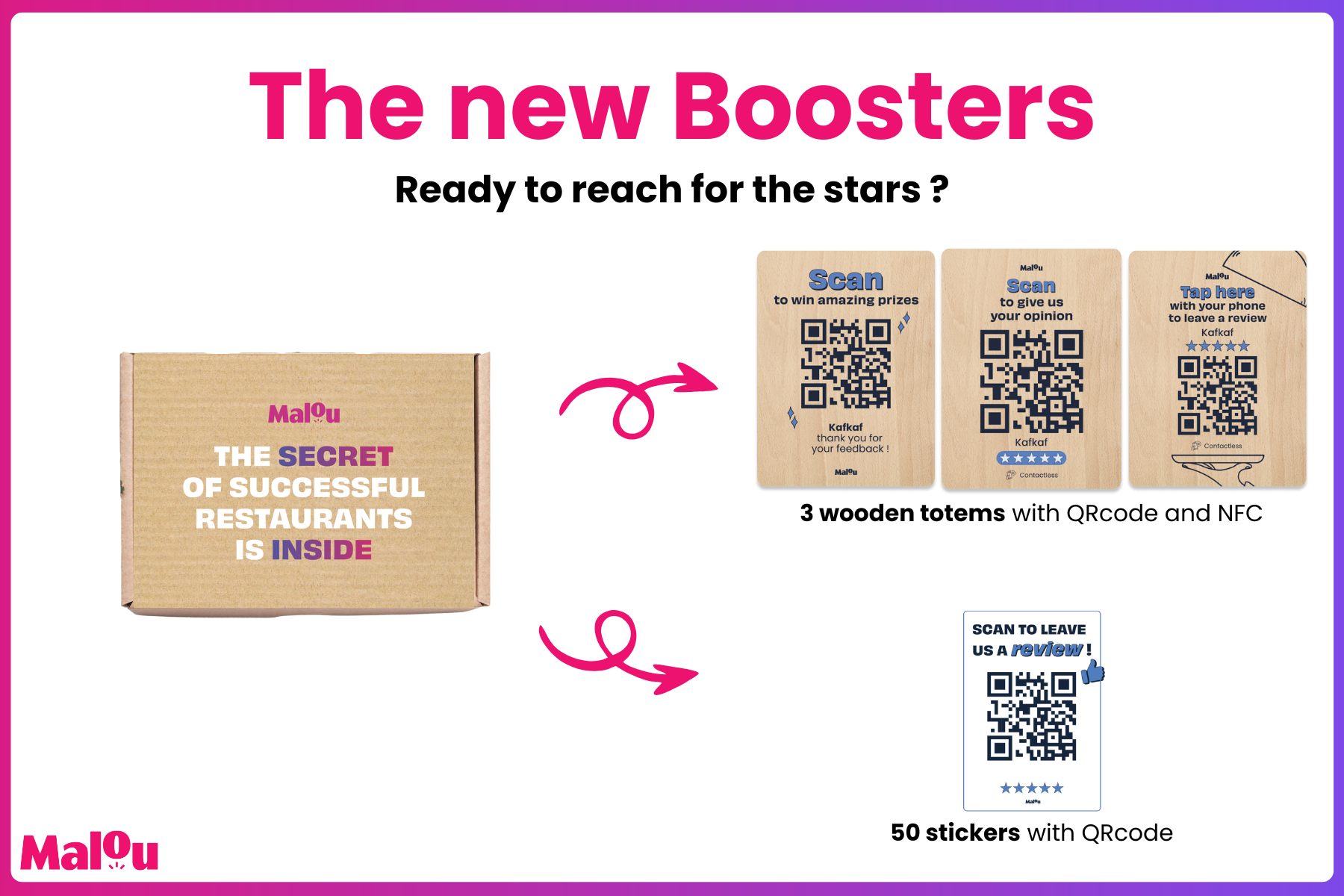
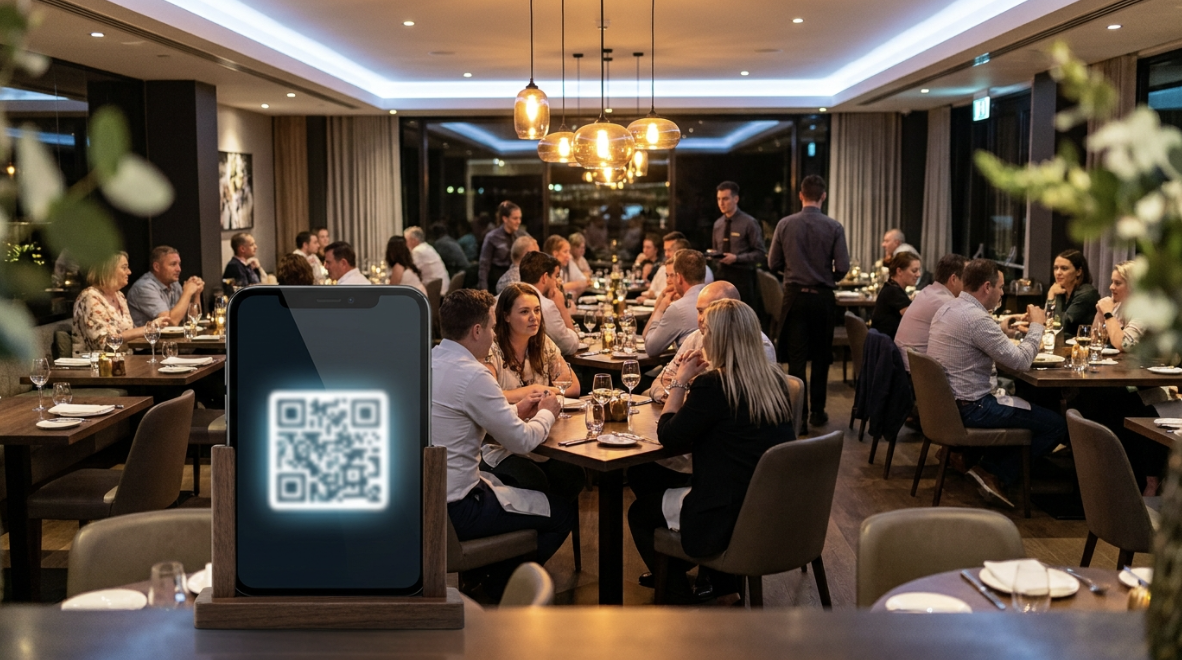
- Boosters or QR codes at every touchpoint. Place QR codes linking directly to your Google review page on receipts, table tents, and exit signage. The fewer steps between "happy customer" and "posted review," the higher conversion. Use QR.io or a similar tool to track scan rates by location.
- Post-visit follow-up via SMS or email. If your reservation or POS system captures contact data, an automated message 2–4 hours after a visit asking for feedback consistently outperforms in-person asks alone. Keep it short and link directly to the review platform.
- Make it specific. Customers who leave reviews after generic prompts write generic reviews. Prompts like "Tell us what you thought of the new spring menu" or "Did you try our cocktails?" produce specific, keyword-rich reviews that carry more local SEO weight.
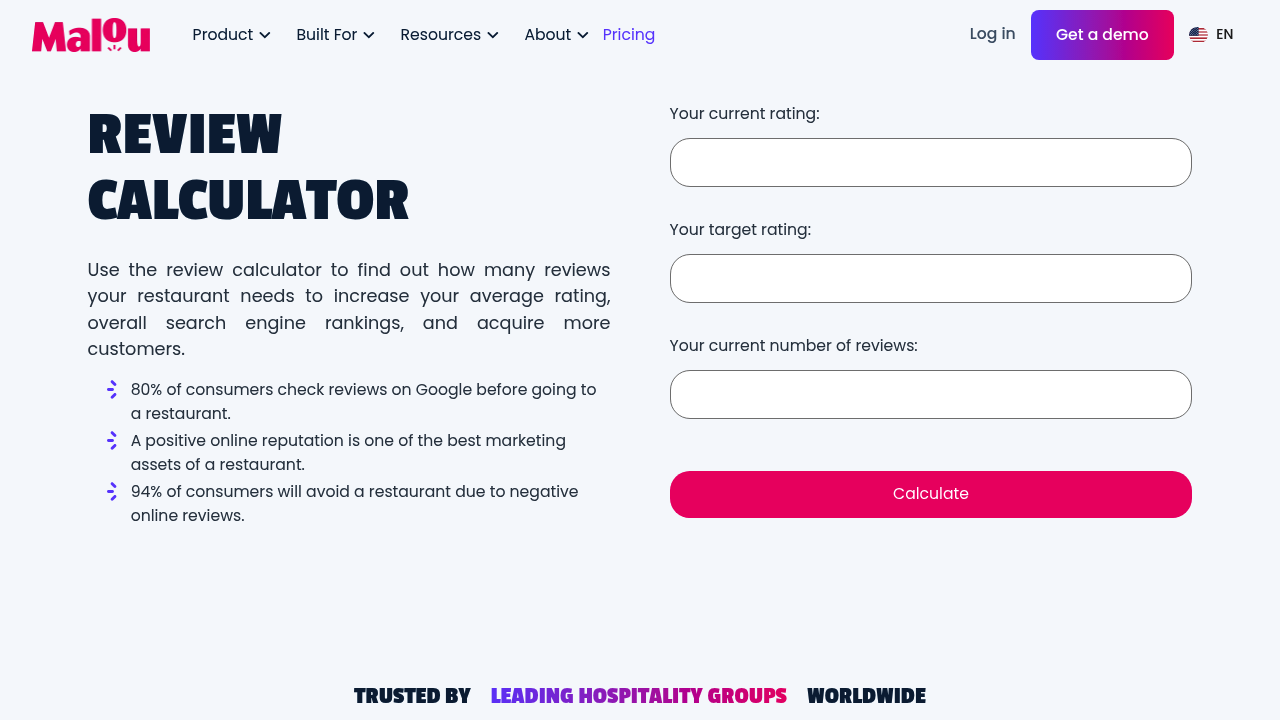
To benchmark where each of your locations currently stands and how many additional reviews you need to move the needle, Malou's free online review calculator gives you a location-by-location view of the gap between your current rating and your target — a useful starting point before building out a review generation campaign.
How to respond to reviews for growth & visibility: our top tips
Responding to reviews is where most restaurants leave value on the table — either by not responding at all or by responding in ways that create more problems than they solve.
Speed matters. Aim to respond within 24–72 hours of any review being posted. According to Review Rescue's 2025 analysis, delays signal disinterest and allow negative sentiment to build momentum. For groups, this means having a defined workflow — not a "whoever sees it first" approach.
Positive reviews deserve real responses. Don't ignore five-star reviews. A response that references a specific detail from the review (a dish mentioned, a staff member named) signals authenticity to both the reviewer and everyone who reads the thread afterward. Keep it warm, brief, and specific. Include your location name and a keyword naturally — this has minor but measurable local SEO value.
Negative reviews require a two-part structure. First, acknowledge the specific issue without becoming defensive. Second, offer a resolution path — a direct email, a name to contact, a genuine invitation to return. Never argue in a public thread. The goal isn't to win the exchange; it's to demonstrate to every potential customer reading the thread that your team takes feedback seriously.
Here's a practical structure for negative review responses:
- Address the reviewer by name if available
- Acknowledge the specific issue they raised
- Apologize without excuses
- Offer a concrete next step (direct contact, manager's name)
- Sign with a real name and location
Fake reviews are a growing problem, especially for groups at scale. Indicators include vague language, no profile history, multiple reviews posted in a short window, and reviews that reference experiences inconsistent with your menu or layout. On Google, flag these via the Business Profile dashboard using the "Report a review" function. Document the evidence before reporting — Google requires it for escalation.
For a comprehensive breakdown of managing fake and negative reviews specifically on Google, Can Restaurant Groups Delete Reviews on Google and How? covers the escalation path in detail.
Review management at scale: what changes for groups
Managing reviews for a single location is manageable with manual effort. Managing reviews across 10, 30, or 100 locations requires a fundamentally different approach.
The main challenges groups face:
- Volume. A 50-location group can receive hundreds of reviews per week across platforms. Without aggregation, reviews slip through.
- Consistency. Tone, response quality, and response time vary wildly when individual location managers handle their own reviews with no centralized guidelines.
- Insight extraction. The value of reviews at scale isn't just reputation management — it's what the aggregate data tells you about operations, product, and team performance. This requires semantic analysis that manual monitoring can't deliver.
- Reporting. Demonstrating review performance improvement to leadership requires data across all locations simultaneously, not location-by-location screenshots.
This is exactly the gap that purpose-built platforms solve.
Top tools for restaurant review management in 2026
1. MalouApp (by Malou) — best for multi-location restaurant groups
Malou is an AI-powered, all-in-one growth platform built specifically for multi-location restaurant groups. Its review management capabilities go well beyond monitoring.
From a single dashboard, Malou aggregates reviews across Google, TripAdvisor, Facebook, Uber Eats, and 50+ other platforms. AI-generated response suggestions are tailored per location — meaning a response for your Paris location doesn't read identically to one for your New York flagship. The platform uses semantic analysis to surface recurring themes across your review corpus: which menu items get mentioned negatively across multiple locations, which service complaints cluster around specific day parts, which locations are outperforming on hospitality scores.
For groups, the competitive differentiation is the combination of automation and intelligence. Malou saves users an average of 28 hours per month, and groups using the platform see an average of +18% more customers per month. Its Copilot tier adds dedicated restaurant marketing experts on top of the software — useful for groups that want strategy execution, not just tooling.
Malou's free review calculator also lets marketing teams quickly estimate how many new reviews each location needs to hit a target rating, useful for setting realistic quarterly goals.
For groups also focused on making their locations easier to find from their own website, Malou's Store Locator is an SEO-powered location finder built specifically for restaurant chains — surfacing each location's reviews, ratings, and key information within a structured, search-optimized framework.
Best for: Groups with 3+ locations wanting to combine review automation, semantic insights, local SEO, and content management in one platform.
2. Birdeye — best for enterprise-scale review monitoring
Birdeye aggregates reviews from 200+ sources and offers a solid response workflow with templating. It's widely used in multi-location retail and healthcare, and works adequately for large restaurant chains. Its analytics dashboard is strong for volume-level reporting but lacks the hospitality-specific semantic analysis and location-level SEO optimization that platforms like Malou provide.
Best for: Enterprise operators who prioritize review aggregation volume and already have a separate local SEO solution.
3. Chatmeter — best for reputation monitoring with social listening
Chatmeter combines review management with social listening and competitive benchmarking. It's solid for groups that want to track how they're perceived relative to competitors in specific markets. Setup and onboarding can be complex for teams without a dedicated digital marketing function.
Best for: Groups with a mature marketing team looking for reputation monitoring alongside competitive intelligence.
4. Podium — best for review generation via SMS
Podium's core strength is automating review requests through text message, which consistently outperforms email in response rates. It integrates with many POS systems and works well for generating Google review volume quickly. Its multi-platform management and analytics are less developed than dedicated reputation platforms.
Best for: Locations in early review-generation mode that want rapid Google review volume through POS-triggered SMS.
The KPIs that actually matter
Most groups track average rating. That's necessary but not sufficient. The metrics that predict sustainable growth:
- Review velocity — how many new reviews each location generates per month. Stagnant velocity signals that collection efforts have stalled.
- Response rate — the percentage of reviews that receive a response. A 2025 Restaverse analysis found 53% of customers expect a response to negative reviews within a week. Groups should target 100% response rate on negative reviews and 80%+ overall.
- Sentiment trend — are the themes in reviews improving or declining over time? Semantic analysis platforms can track this automatically.
- Rating gap vs. competitors — your absolute rating matters less than your rating relative to nearby competitors. A 4.1 in a market where every competitor averages 3.8 is stronger than a 4.3 where competitors average 4.5.
- Platform coverage — what percentage of your locations have active, claimed profiles on the top three platforms? Unclaimed profiles are invisible to algorithms and unmanageable in a crisis.
For local SEO for restaurants, review signals work in concert with profile completeness, NAP consistency, and posting frequency — tracking reviews in isolation misses the bigger picture.
Building a review management SOP for your team
Systems beat intentions at scale. Every group should have a defined standard operating procedure that answers:
- Who is responsible for monitoring reviews at each location?
- What's the maximum response time target (24 hours is the industry standard; 48 hours is the floor)?
- What escalation path exists for one-star reviews or crisis-level feedback?
- How are response templates maintained and updated across locations?
- How is review performance reported to leadership, and on what cadence?
Without this SOP, review management defaults to whoever notices a notification — inconsistent, slow, and impossible to improve systematically.
For a broader view of how review management fits into a complete restaurant marketing operation, Best Restaurant Marketing Tools for 2026 covers how the top platforms integrate review management with local SEO, social media, and analytics.
The 2026 reality: reviews are infrastructure, not afterthought
The restaurants and groups that will dominate local search in 2026 — on Google Maps, in AI-generated recommendations, on every discovery platform — are the ones treating reviews as infrastructure rather than PR cleanup.
That means active collection, systematic response, semantic analysis for operational insight, and platform-level integration with local SEO and GEO strategies. For groups, that's not achievable through manual processes or general-purpose tools — it requires platforms built for the specific complexity of multi-location hospitality.
The good news: the competitive advantage for groups that build this system now is significant, because most of their competitors still haven't.
To know more about how you can leverage your reviews, feel free to call a Malou's reputation expert at +1 (929) 483 0848 or book a demo here.

We put The double bites to satisfy you
Increase your visibility on Google and social networks with Malou.
