

The Best Restaurant Marketing Software for Groups: The 2026 Buyer’s List (AI + ROi)

.png)
Analyze your online performance and competitors, and get a comprehensive audit with personalized advice!
Any successful restaurant owner will tell you hospitality is a low margin game.
When it comes to communication & marketing, investment choices can make or break your business. Each effort has to generate either revenue, tangible value or save time.
Whether you are a founder or a CMO, you’ve probably tried dozens of tools over the years, some more crucial than others.
Ten years ago, measuring the profitability of these tools was practically impossible. Today, AI innovations in hospitality and new digital marketing solutions have drastically changed the game, allowing professionals to forecast results, act on live data and measure growth for each location.
Thanks to these innovations, marketing, especially online marketing, has become a core strategy to grow restaurants’ profits.
Whether it’s state of the art AI tools for restaurants or simple free marketing tools, apps for restaurant owners are more efficient, easier to use, combine, and more lucrative than ever.
During the 2025 FS/TEC, the most profitable franchises attending the event revealed AI-driven optimization increases revenue by +5% to +12% per location.
To outperform the competition in 2026, your marketing stack must move beyond a bundle of tools to a strategic framework based on essential pillars.
Which marketing software is worth the hype? How do you choose the right one and make sure it’s truly suited for your needs?
👉 Here’s our top selection, field-tested and proven.
Don’t let AI hide your locations 👀 Use it for growth and visibility! 🎬 Watch the replay "How AI is Reshaping Hospitality and How to Leverage AI to increase revenue"
How to Pick a Marketing Software for Your Restaurants:The Checklist
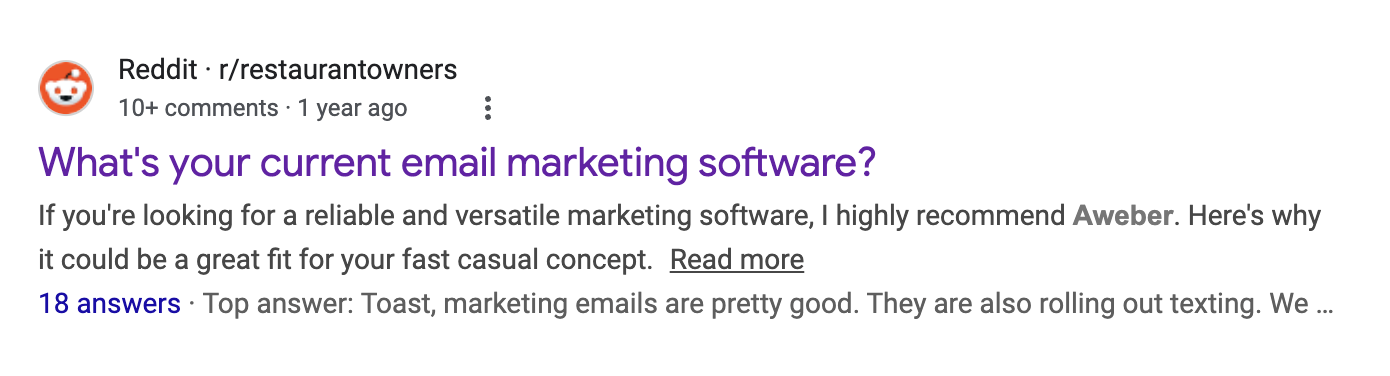
A simple Google search will show you that picking a Marketing Software is one of the top questions for restaurant owners of Reddit (over +20 threads!). Professionals want concrete tips with proven results.
Whether you own 3, 15 or 100 locations, keeping an eye on profits and prioritizing revenue-driving actions is key to grow your brand.
When it comes to marketing software, you need high-ROI tools designed to deliver strong performance at headquarters and across every location.
👉 Here’s the checklist of what to look for in 2026 :
- Pick only a handful of marketing softwares (less is more);
- Make sure these marketing solutions can all stack up;
- Make sure they will evolve in time (they won’t be obsolete in a year or two);
- Make sure that you and your teams will actually use them everyday. There’s no point in investing in a shiny new tool that no one will use because it’s too complicated or simply irrelevant regarding what you need;
- Ideally, make sure the tool can help you run multiple locations from the start, if you plan on expanding your brand;
- Look for AI-native tools, with AI embedded across every layer of the product;
- Choose software built by reliable, established players with a proven track record in hospitality and built by operators and experts.
The perfect marketing software should feel seamless, be used by all and save time. Focus on substance, not hype.
The 2026 Essential Stack: Top 7 Marketing Software Solutions for Groups
1. Malou: The AI-Powered Digital Backbone for Visibility & Growth
- Website: malou.io
- Best for: Multi-location operators seeking a complete digital marketing ecosystem for visibility and acquisition.
Malou is the top one-size-fits-all digital marketing solution for hospitality groups. The MalouApp serves as the architectural bedrock for digital visibility, unifying local SEO, GEO, online reputation, presence management, social media, etc. into a single enterprise dashboard that you and your team can use anywhere from you smartphones or desktop.
Malou trains its own Artificial Intelligence (hospitality-focused) and integrates it across layers of the solution to maximize content creation, automation and data-backed reports and analysis.
Other key advantage: Malou is a stack-agnostic solution that can plug into your existing tools.
🚨 In 2026, the most critical shift online is the centralizing of Search & Discovery. For groups, being n°1 online means working on the "Google-Meta-Apple-Yelp" axis. Impact is maximized when all digital pillars work together, creating a virtuous cycle and exponential performance.
A Malou's comprehensive 2025 study on 2,000+ restaurant locations showed that groups centralizing their SEO and local listings (Google Maps, Instagram, Apple Maps) saw:
- +74% Organic Traffic in just 3 months.
- 2.5x Higher Discovery Rate on Google Maps when visuals and listings were unified across all locations.
- Result: This translated to a +4.7% average revenue growth per location.
Key Features:
- Presence Management: Native integration with 60+ platforms and directories (Maps, Yelp, TripAdvisor, OpenAI) ensuring absolute data consistency for the "Trinity" pillars.
- Store Locator: Automatically generates local pages with a 97/100 PageSpeed score. This is a critical technical requirement for GEO; pages with complete structured data are 3.6x more likely to appear in AI-generated summaries.
- GEO & Retrievability: Ensures brand visibility in ChatGPT, Perplexity, and Gemini by structuring data so AI doesn't just "rank" the site but "retrieves fragments of meaning" to answer specific user prompts.
- Reputation & Semantic Analysis: AI-assisted review replies save 28 hours per month per location. More importantly, it performs semantic analysis across five key drivers—Price, Cuisine, Service, Ambiance, and Hygiene—detecting operational issues three weeks before they impact sales.
Malou erases the need for fragmented agencies and siloed tools, allowing headquarters to maintain brand consistency for groups like Krispy Kreme and Nowon NYC while empowering local managers with automation.
2. OpenTable: Insights + Automations for Demand Generation
- Website: opentable.com
- Best for: Reservations, demand forecasting, and mid-week optimization.
OpenTable has evolved into a sophisticated revenue engine. Beyond a booking platform, it functions as a demand-generation layer that utilizes AI to solve the industry’s greatest pain point: occupancy variance.
Key AI Features:
- Predictive Demand Insights: Identifies high and low demand dayparts to assist managers in adjusting availability.
- Automated "Experiences": Triggers targeted promotions to drive volume during off-peak hours.
- AI Guest Segmentation: Automatically categorizes guests for personalized follow-ups.
When reservation data is paired with visibility insights from Malou, operators can finally correlate "Directions" on Google Maps directly to "Seated Covers," closing the loop on acquisition ROI.
3. Toast AI: Operational Intelligence and POS Synergy
- Website: pos.toasttab.com
- Best for: POS data, menu intelligence, and labor optimization.
Toast AI serves as the "AI operations command center" for high-growth enterprise brands like CAVA, Wingstop, Sweetgreen, and Shake Shack. It bridges the gap between marketing promise and operational execution.
Key AI Innovations:
- Menu Engineering: AI analysis of modifiers and upsells to maximize check size.
- Demand Forecasting: Sales volume predictions that inform labor models, ensuring staffing matches forecasted guest counts.
- POS-Marketing Synergy: Connecting Toast to a visibility platform like Malou allows marketing teams to tie specific keyword rankings and social engagement directly to terminal revenue.
4. SevenRooms AI: Enterprise CRM and Guest Personalization
- Website: sevenrooms.com
- Best for: Guest relationships, high-LTV identification, and personalized post-visit funnels.
Retention is the mandatory second half of the growth equation. SevenRooms focuses on identifying and protecting high-LTV (Long-Term Value) guests for groups like Major Food Group and Tao Hospitality.
Key Strengths:
- Predictive Loyalty: Identifies churn risks and high-spenders through AI-driven guest tags (e.g., "VIP," "High-Spender," "Brunch-lover").
- Automated Marketing Funnels: Triggers personalized post-visit emails based on actual dining behavior.
To maximize the ROI loop, the "acquisition data" from Malou’s SEO engine must feed into the "retention engine" of SevenRooms, ensuring that guests acquired through AI search are converted into lifelong regulars.
5. Olo: Digital Ordering Infrastructure and AI Upselling
- Website: olo.com
- Best for: Digital ordering, delivery intelligence, and large-scale loyalty.
Olo provides the infrastructure for direct-to-consumer ordering, allowing brands like Five Guys and Wingstop to reduce reliance on third-party marketplaces.
Key AI Features:
- Smart Upsells: Dynamic suggestions during checkout based on individual guest history.
- Order Throttling: Real-time AI management of kitchen capacity to protect the guest experience during peak surges.
- Delivery Intelligence: Predictive performance modeling for speed and accuracy.
6. Canva AI: Design Automation for Multi-Unit Consistency
- Website: canva.com
- Best for: Social media content, LTO graphics, and franchise brand kits.
Canva AI solves the problem of brand dilution during rapid expansion by centralizing design assets into shared brand kits for franchise networks.
Key Features:
- Magic Design: Instant AI-generated templates for menu launches and seasonal promotions.
- Brand Kits: Enforces strict adherence to logos, fonts, and hex codes across all units.
While Canva is an elite design asset tool, it lacks the technical SEO capabilities required for visibility. Groups should use Canva for creative production and Malou to automate the publication and SEO-optimization of these assets across Google and social channels.
7. Mailchimp: Precision Email Marketing and Reactivation
- Website: mailchimp.com
- Best for: Post-visit campaigns, reactivation flows, and segmented newsletters.
Email remains the primary bridge for direct guest feedback and repeat-visit incentives.
Key Signals:
- Reactivation Flows: Automated triggers for guests who have not visited in 30, 60, or 90 days.
- Segmentation: Delivers distinct messaging to "Local Regulars" versus "Out-of-Town Tourists."
The strategic value of Mailchimp lies in its ability to generate direct guest feedback, which provides a secondary channel for review requests that ultimately fuel the SEO and GEO visibility engine.
Final Takeaway: Building Your 2026 Full-Stack Ecosystem
In 2026, the restaurant groups scaling with the highest margins are not the ones "doing more marketing"—they are the ones using AI to decide what marketing to do. Visibility is the absolute foundation of every AI strategy; if ChatGPT, Gemini, or Perplexity cannot "read" your restaurant’s entity through structured data and Store Locators, your locations simply do not exist to the modern diner.
A successful stack unifies visibility, operations, and the guest experience into one cohesive ecosystem. To understand where your brand stands in this new agentic landscape, we recommend a data-backed diagnostic.
Book a 30-minute "Free AI Visibility Audit" with Malou to analyze your current SEO and GEO performance, or call +1 (929) 483 0848 to speak with one of our top expert.
FAQ: The Top Restaurant Marketing Softwares at a Glance
Q1: What are the best restaurant marketing tools for groups in 2026?
A high-performance stack includes Malou for visibility (SEO/GEO/Reviews), OpenTable for reservation demand, and Mailchimp for CRM and reactivation.
Q2: How do these marketing tools impact ROI?
Multi-location groups utilizing unified AI tools see an average revenue uplift of +4.7% per location, a 25% increase in Google review volume, and an average rating lift of +0.3 stars within six months.
Q3: How much should restaurant groups invest in marketing software?
Industry benchmarks suggest an investment between 3% and 6% of gross revenue. Franchisors typically lean toward 5% to ensure brand consistency and data alignment across the network.
Q4: Why is AI fundamentally changing restaurant marketing?
AI automates high-volume, low-value tasks like review replies (saving ~30 hours per month) while providing deep semantic analysis of guest sentiment. This allows operators to identify operational friction points before they manifest as a drop in revenue.
.jpg)

We put The double bites to satisfy you
Increase your visibility on Google and social networks with Malou.
