

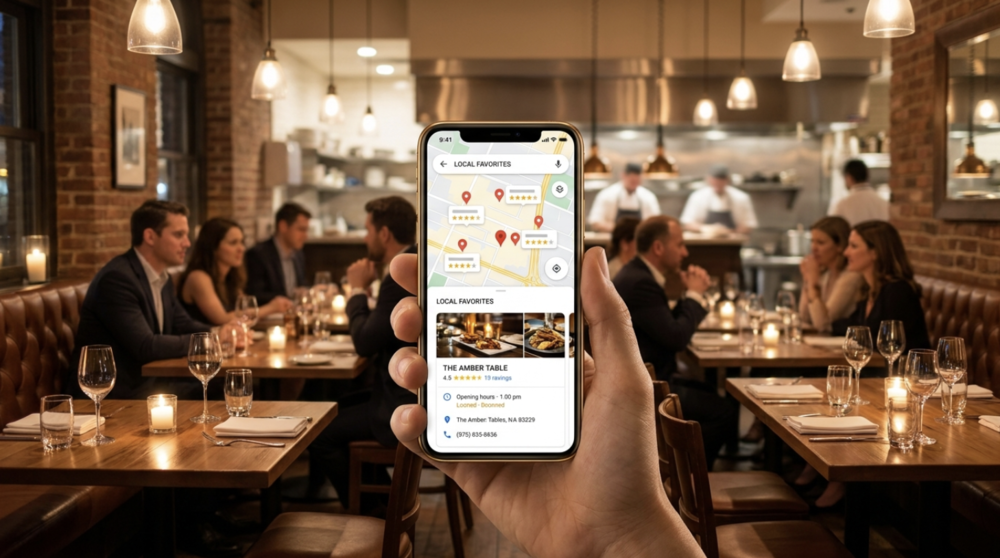
Structured data for restaurants: the complete 2026 guide

Find out where you stand, spot what’s holding you back, and get a custom action plan to outrank your competition.
When a diner searches "Italian restaurant near me," Google doesn't just match keywords — it parses structured signals from across your digital footprint to decide which restaurants deserve prominent placement.
In local SEO and GEO, structured data is one of the most direct signals you can send as a local business. That signal is structured data. And most restaurant groups are leaving it untouched.
A SearchPilot experiment found implementing structured data on business pages drove a 20% CTR lift within 30 days.
According to The Structured Data Company, rich results capture 58% of all clicks, versus 41% for non-rich results.
For restaurant groups, the stakes are even higher. Each location is a discrete entity that needs its own machine-readable identity.
This guide explains what structured data does for your business — not how to write code, but why it moves revenue, how it feeds AI discovery, and how leading hospitality groups are scaling it across dozens of locations without adding to their workload.
Why structured data matters for restaurants: The Multi-Location Problem
A single-location restaurant can implement structured data once and maintain it with modest effort. For a group managing 10, 20, or 50 locations, the challenge is categorically different.
Each location needs its own address, its own hours, its own attributes, its own rating data. And all of it must be consistent — not just internally, but across every platform where that location is listed.
Any discrepancy between your structured data and your Google Business Profile creates conflicting entity signals.
A phone number formatted differently on two platforms is enough to introduce doubt about whether these are the same business.
The data is stark: only 30% of restaurants have a fully complete Google Business Profile. 40% don't have a menu link on their GBP. The bigger the group, the bigger the gaps — and the more revenue each gap costs.
The other risk is version drift. When hours change at a location, that change needs to cascade to your local page, your GBP, and every directory simultaneously. Managing this manually across 15+ locations creates version drift within weeks of launch. The groups winning in local and AI search treat structured data as live infrastructure, not a one-time setup.
What Structured Data Actually Is (In Plain Business Terms)
Structured data is a standardized format added to your website pages that tells search engines and LLM (AI tools) exactly what each piece of information means. Think of it as the difference between giving Google a brochure about your restaurant and giving it a filled-in form.
With a brochure, Google has to guess: are those numbers a phone number or a reservation line? Is "Fri 6–30" your hours or an event date? With structured data, there is no guessing. Google knows your address is an address, your hours are your hours, your rating reflects 847 verified reviews, and your cuisine is Japanese. That certainty directly translates to ranking power.
Search engines understand natural language poorly compared to structured data like JSON-LD.
When you embed JSON-LD on a location page, you're telling Google's Knowledge Graph exactly what your restaurant is, where it sits, what hours it keeps, what cuisine it serves, and how diners rate it.
The payoff is concrete. Correctly implemented restaurant schema can unlock:
- Knowledge Panel fields — name, address, phone, hours, and cuisine displayed directly in the SERP
- Rich snippets — star ratings and review counts beneath your organic listing
- Menu features — dish names and prices surfaced in Google Search and Maps
- Local Pack enhancement — stronger category and attribute signals that feed Maps ranking
- AI Overview eligibility — according to Malou's December 2025 GEO webinar, AI engines cross-reference Schema.org markup as a core trust signal when building restaurant recommendations
This last point matters as AI-driven discovery grows. Malou's internal Study across 3,500+ restaurant customers shows that locations with fully structured local pages see up to +74% more organic traffic after 3 months compared to those relying on unstructured content alone.
The SEO Payoff: What Structured Data Unlocks in Search
When your location pages carry properly structured data, Google can surface:
- Rich snippets — star ratings and review counts visible in organic results before a single click
- Knowledge Panel data — name, address, phone, hours, and cuisine displayed directly in the results panel
- Menu features — dish names and categories surfaced in Google Search and Maps
- Opening hours inline — accurate, real-time hours including holiday variations
- Local Pack enhancement — stronger signals that push your locations toward the top-3 map pack
The GEO Shift: Why Structured Data Is Now Your AI Translator
The SEO argument alone would justify structured data for any restaurant group. But in 2026, the stakes are higher. GEO — Generative Engine Optimization — the practice of making your locations recommendable by AI tools like ChatGPT, Gemini, and Perplexity — depends directly on structured data.
AI engines don't rank pages. They identify entities — specific, verifiable businesses that match a query with high confidence. When someone asks ChatGPT "best outdoor brunch spot in Austin with vegetarian options," the model draws from a network of structured signals it has already indexed: your Google Business Profile, your local pages, your third-party directory listings, and the structured data markup that ties all of them together as one consistent entity.
Being excluded from AI search is now costlier than ranking on page 2. AI responses typically include 2–5 recommendations, not 10 links. The estimated conversion rate of AI-driven restaurant discovery is ~6.7% vs ~3.9% for traditional Google search. Structured data is the infrastructure that gets your locations into that pool.
One specific signal worth understanding: the same-as field in your structured data lists all the external platforms where your restaurant is present — Google Maps, TripAdvisor, Yelp, your delivery platforms. AI engines cross-reference these to validate your restaurant's identity. The more platforms your structured data cites consistently, the more confident AI is in recommending you. Every inconsistency — a different phone number, a mistyped address — reduces that confidence.
Note: Google deprecated FAQ rich results in May 2026, meaning FAQ markup no longer generates expandable panels in Google SERPs. However, it retains significant value for AI engines — ChatGPT, Perplexity, and Claude use it to extract direct answers about your location. FAQ schema on local pages remains a worthwhile AI discoverability signal.
Why Your Store Locator Is Your Most Valuable Structured Data Asset
For restaurant groups, the practical answer to "how do we deploy and maintain structured data at scale" is a purpose-built store locator with local pages. Not a "find us" widget. Not a single contact page listing all your addresses. A fully indexed, content-rich local page for every location — each automatically carrying the structured data it needs to compete.
The difference in outcomes is significant. A group with 20 locations and a proper store locator has 20 competing entities in Google's index, each building its own local authority, each ranking for its own neighborhood keywords, each feeding AI recommendation engines with consistent entity data. A group without it has one brand website trying to do the work of 20 restaurants — and losing at every local search query.
Malou's Store Locator was designed specifically for multi-location hospitality groups. Every local page it generates deploys with automatic Restaurant schema markup and real-time GBP synchronization. Reviews and Instagram content are injected dynamically. The average Google PageSpeed score across Malou-built local pages is 97/100.
Adding a new location automatically creates its local page with the right structure from day one. Malou's presence management enforces NAP consistency automatically across 50+ platforms — eliminating the schema-GBP mismatch risk that accumulates silently across large networks.
See where your locations stand. Malou's free visibility audit maps the structured data gaps across your network — schema mismatches, GBP inconsistencies, and AI discoverability blind spots.
For a broader look at how restaurant SEO trends are shifting toward AI-native discovery, or to understand the full scope of local SEO for multi-location groups, structured data is the foundational layer everything else builds on.
Don't let your website lose clients because you lack structured data. Book a demo with a Malou expert or call us at +1 929 483 0848.
Frequently Asked Questions about Structured Data for Restaurants
Does structured data directly improve Google rankings?
Structured data is not a direct ranking factor, but its effects on ranking are real. It unlocks rich results that dramatically improve click-through rates — and higher CTR is a behavioral signal Google weights in its ranking model. For local businesses, it also strengthens entity associations in Google's Knowledge Graph, which feeds directly into Local Pack placement. Net effect: up to +74% organic traffic for restaurant groups with fully structured local pages.
Is structured data required for AI search visibility?
Not strictly required, but it is one of the strongest signals an AI engine can use to identify and recommend your locations with confidence. Restaurants with consistent, complete structured data across all their local pages and directory profiles are significantly more likely to appear in AI search responses than those relying on unstructured content alone.
How many structured data blocks does a restaurant group need?
One per location, on that location's dedicated local page. Never consolidate multiple locations into a single block — each location is a discrete entity and needs to be indexed as such. For a group with 20 locations, that means 20 separate local pages, each with its own schema block. This is exactly what a purpose-built store locator like Malou's automates.
What happens to FAQ schema after Google's May 2026 deprecation?
Google deprecated FAQ rich results in May 2026, so FAQ markup no longer generates expandable Q&A panels in Google SERPs. However, FAQPage schema retains significant value for AI engines: ChatGPT, Perplexity, and Claude use it to extract direct answers about your location. For local pages, it remains a worthwhile AI discoverability signal — it just no longer produces visible enhancements in Google Search.



We put The double bites to satisfy you
Increase your visibility on Google and social networks with Malou.
