

Google Maps starts taking orders: what Ask Maps means for restaurant groups

.png)
Analyze your online performance and competitors, and get a comprehensive audit with personalized advice!
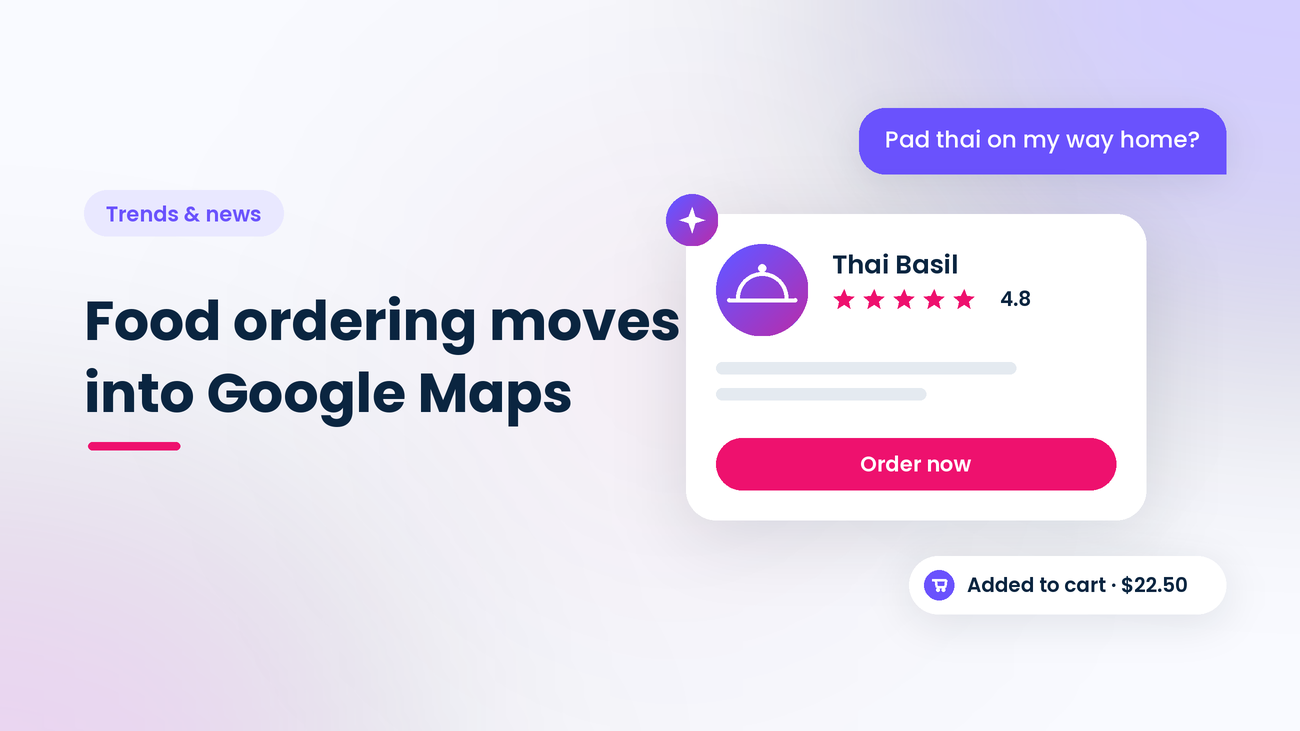
On August 6, 2026, Google showed the next chapter of the story. Its demo fits in a single sentence addressed to Google Maps: "order spicy pad kee mao with seafood for me to pick up on my way home." And Maps gets to work: it finds restaurants open along your route, checks who serves the dish, builds the cart and leaves you to review and pay.
The capability is called Ask Maps: the conversational assistant built into Google Maps since March has just gained so-called agentic capabilities. It no longer just answers questions — it executes multi-step tasks.
Only days earlier, we covered how table booking moved into ChatGPT through Yelp, OpenTable and Resy. Google just answered — on its own turf, with its own weapons. And that turf is the world's most-used local discovery surface.
What Ask Maps can actually do
Food ordering is the first brick. The user phrases a request in natural language — a dish, a route constraint, a dietary need — and Ask Maps chains the steps: restaurants open along the route, menu matching, saved places and dietary preferences taken into account, then the dish added to the cart. Review and payment stay in the customer's hands, on the partner platform.
At launch, two partners: Square and Toast — point-of-sale systems, not marketplaces. Uber Eats is coming soon. One detail that matters for operators: with Toast, orders placed through Ask Maps run through the restaurant's own ordering system, with no third-party commission fees.
Dining is only the beginning: Ask Maps also compares hotel prices and checks availability in real time, surfaces event tickets, and — with explicit permission — can draw on Gmail and Google Calendar to personalize its answers. The rollout starts in the US.
Chapter two of the same story
Barely two weeks after the Yelp x OpenAI deal, this launch confirms the pattern we described: each platform plugs AI into its own strengths. OpenAI had no local data — so it licensed Yelp's corpus and integrated the reservation networks. Google already owns the world's largest local corpus — listings, reviews, photos, hours — so it plugs in the transaction itself.
One element flew under the radar and deserves attention: Google is co-developing a "Universal Commerce Protocol" for food with Square, Toast and others — an open standard defining how AI agents discover a restaurant, order and pay, whatever the interface. Translation: what's being built here won't serve Google Maps alone. Tomorrow, any agent speaking that protocol will be able to place an order with you — or with your competitor.
What it changes for a multi-location group
Your business listing becomes transactional. Until now, a well-kept Google Business Profile helped you get found and chosen. From now on, the agent reads it to act: exact hours to know whether you're open along the route, attributes to filter, menu data to match the requested dish. A wrong opening time is no longer an inconvenience — it's an order that goes to the competitor next door.
The structured menu becomes the condition of existence. An agent doesn't "read" a PDF — it queries data. A dish properly recorded — name, price, description, dietary tags — in your POS and your listings is orderable by an agent. A dish that only exists as a photo or a PDF is invisible to it. Menu data quality, long treated as housekeeping, becomes a direct commercial issue.
Your point of sale becomes an acquisition channel. The choice of launch partners — POS providers rather than marketplaces — says something: the connection between your POS and the AI ecosystems determines whether customers can order from you without an intermediary, and on what economic terms. At group scale, "are our tools plugged into these protocols?" becomes a strategy question.
And as always: one more channel to measure. An order initiated in Maps and completed on the partner platform can easily slip past your dashboards. Add a "Google Maps / AI" option to your tracked order sources now.
How to get ready
The agentic rollout starts in the US. Wherever your locations are, the same logic applies: the groups whose data is ready when the agent arrives will take the early advantage — as with every platform shift.
Four projects to open now:
- Make your Google Business Profiles bulletproof at every location: hours (including special hours), attributes, ordering and booking links. That's the agent's raw material. Our Google Business Profile guide for restaurants shows you how.
- Structure your menus. Every dish as text, with price, description and dietary tags — on your listings, your website (schema.org markup) and your POS. A PDF can no longer be the only format. See our structured data guide for restaurants for the full walkthrough.
- Map your connections. Which POS, which online ordering channels, which Google integrations? Ask your vendors the question: will AI agents be able to order from us?
- Keep your reviews alive. The corpus feeding Google's agent is the one on your listings: volume, recency and responses remain the foundation. Our 9-point checklist is still the right starting point.
The bottom line
In two weeks, ChatGPT integrated reservations, and Google Maps integrated ordering. Local discovery is shifting from a search logic — ten links, you choose — to an agent logic: one request, one execution. In that world, your listings, your menus and your technical connections no longer just describe your restaurant: they make it orderable, or not.
At Malou, we help restaurant groups manage their local visibility — listings, reviews, content — across every location, and get ahead on emerging AI channels. Test your group's visibility with our audit tool.
We put The double bites to satisfy you
Increase your visibility on Google and social networks with Malou.
