

.jpeg)
The Local SEO Platforms Restaurant Groups Really Need to Rank in 2026

.png)
Stop losing guests to AI. Watch the exclusive session to audit your visibility and outrank every local competitor.
When it come to local SEO, restaurant groups face a unique challenge in online marketing: every location needs to rank locally.
SEO for restaurant chains means managing dozens of locations with specific local needs and specific GBP.
The most profitable franchises know it: they need to maintain accurate listings, rank each restaurant on Google and convert online discovery into foot traffic—all without adding operational complexity.
In a nutshell?
The right local SEO platform is the one that drives measurable customer acquisition across every location.
What Makes a Local SEO Platform Essential for Restaurant Groups?
Multi-location restaurant operators need platforms that centralize presence management, automate review workflows, and deliver location-specific SEO strategies for chains.
When 76% of diners search online before choosing where to eat and 59% of clicks go to the top three results on Google Maps, being invisible in local search means leaving thousands of customers—and significant revenue—on the table.
The best referencing platforms combine the following:
- Presence management across 50+ directories,
- Presence management accross +40 applications,
- AI-powered content generation that maintains brand consistency per location (ex: a Store Locator)
- Centralized local pages for each location (ex: a Store Locator made for restaurants)
- Centralized reputation management on an App with real-time analytics,
- Tailor-made keyword strategies that help each restaurant rank for its hyperlocal market.
Here are the top five local SEO platforms (especially AI tools for hospitality groups) leading the category in 2026.
1. Malou – All-in-One Growth Platform Built for Restaurant Groups
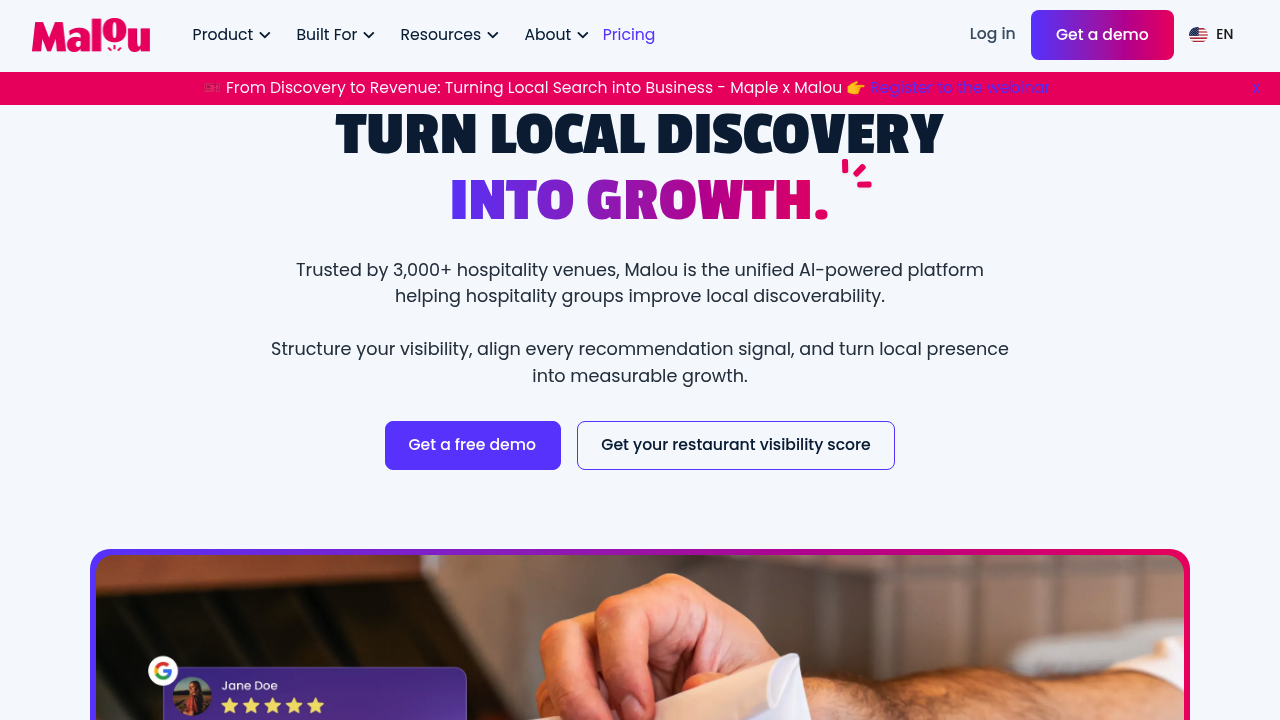
Malou is purpose-built for multi-location restaurant groups that need to scale marketing execution without adding headcount. The platform addresses the exact problem restaurant operators face: maintaining consistent visibility and engagement across dozens or hundreds of locations while keeping each restaurant's identity authentic to its local market.
Core Capabilities:
- Presence management across 50+ platforms (Google, Facebook, Instagram, TripAdvisor, Uber Eats, OpenTable) with one-click syncing
- Location-specific local SEO with tailor-made SEO keyword strategies per restaurant
- AI-powered review responses and social content generation that stays on-brand
- Unified inbox for reviews, messages, and social interactions
- Real-time analytics and location performance comparison
- MalouApp (self-serve platform) and Copilot (platform + dedicated marketing experts)
Best For: Restaurant groups with 3+ locations that want measurable ROI from local search, including independent multi-location operators, emerging chains, and enterprise brands.
Pricing: MalouApp starts at $339/month per location with a 12-month commitment. Copilot pricing is custom and includes dedicated marketing support plus AI-driven strategy.
Proven Results: Malou clients save an average of 28 hours per month, win +18% more customers per month, and reach 350% more people online. Internal studies show groups centralizing their digital strategy with Malou see +174 new customers per month per location.
Malou's differentiator is its integration of AI that reduces manual work while preserving authenticity for each location. Restaurant groups using the platform report significant time savings in managing Google Business Profiles, responding to reviews, and publishing social content—freeing teams to focus on in-store operations and guest experience. Learn more about the most efficient SEO tips for restaurants or explore 12+ ways to optimize Google Business Profile.
2. SOCi – Multi-Location Marketing with AI Agents
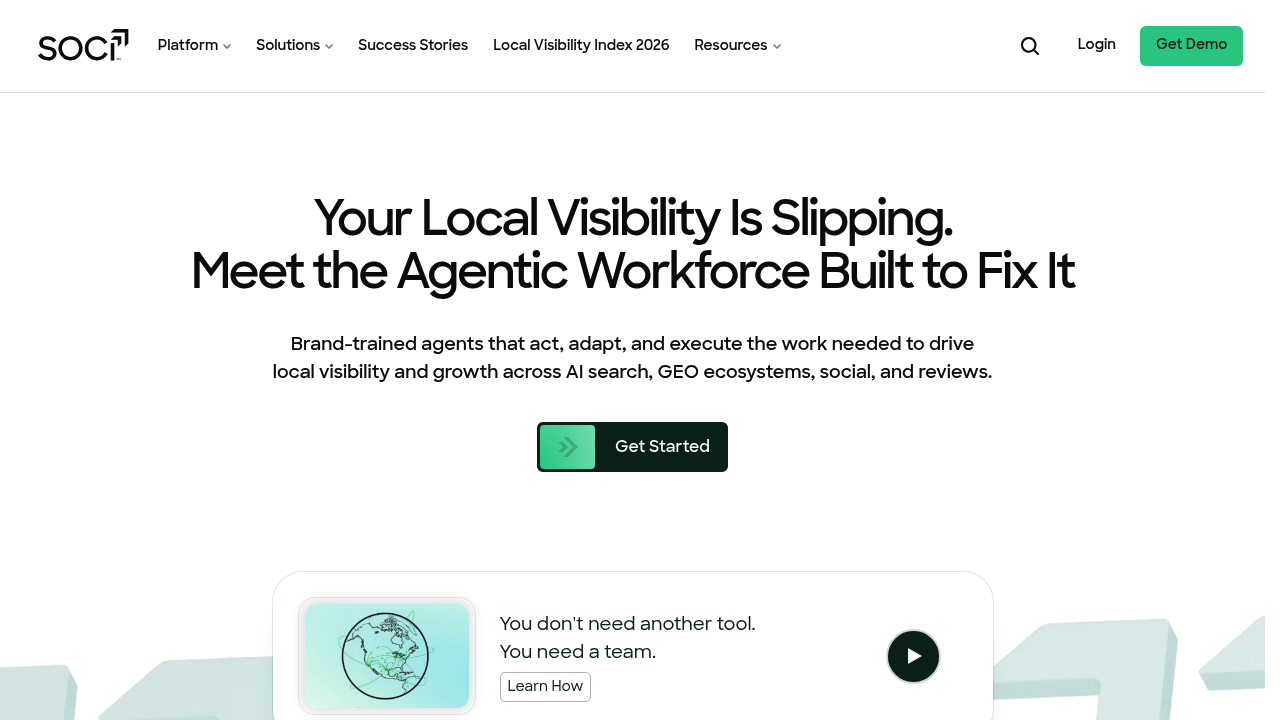
SOCi positions itself as an AI-driven multi-location marketing platform with modular "Genius" agents for search, social, reputation, pages, and advertising. The platform is designed for enterprise brands managing large location counts and complex marketing workflows.
Core Capabilities:
- Genius Search Agent for listings and local search optimization
- Genius Social Agent for content publishing and scheduling
- Genius Reputation Agent for review monitoring and response
- Pages, Ads, Chat, Surveys, and Store Locator modules
- Enterprise-grade integrations and compliance controls
Best For: Large multi-location brands (50+ locations) with dedicated marketing teams and enterprise IT requirements.
Pricing: Custom enterprise pricing; not publicly disclosed.
SOCi is a strong choice for brands that need deep integration with existing martech stacks and have the internal resources to manage enterprise software. However, the platform's complexity and lack of transparent pricing can make it less accessible for mid-market restaurant groups looking for straightforward ROI and faster implementation.
3. Uberall – Location Performance Optimization Platform
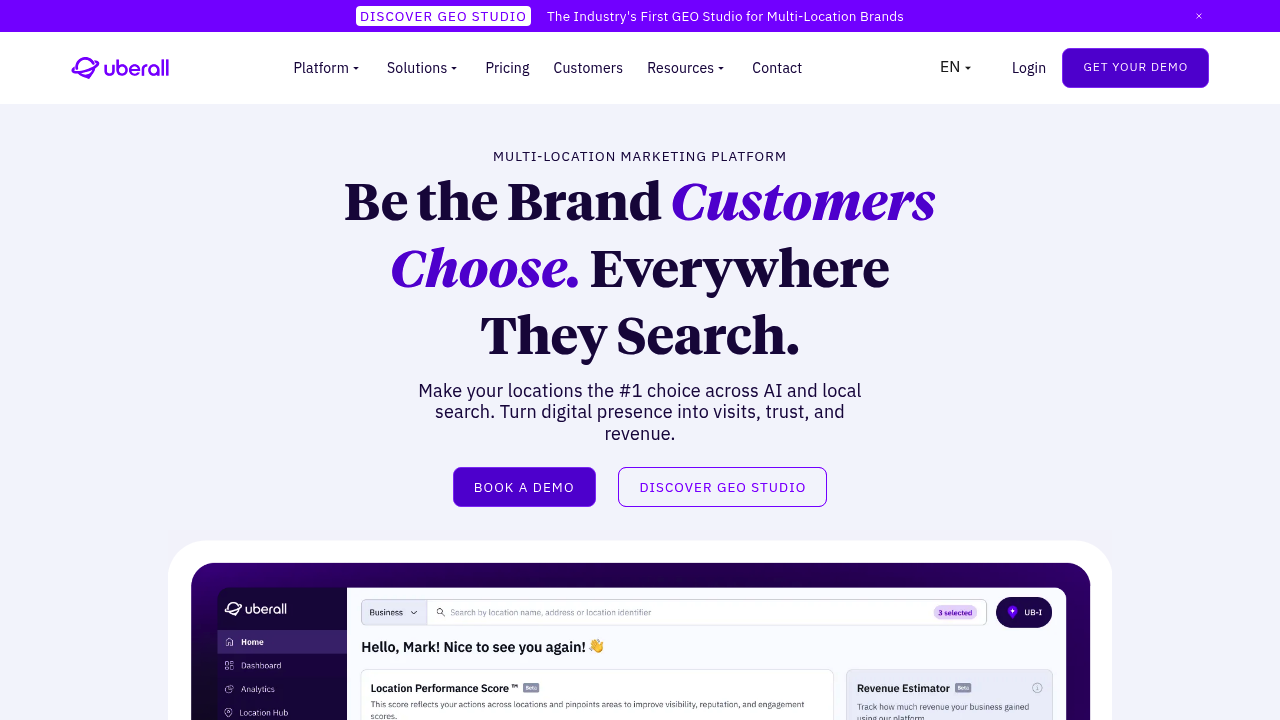
Uberall delivers multi-location marketing with a focus on visibility, reputation, conversions, and engagement. The platform highlights its UB-I agentic AI, Geo Studio for competitive analysis, and modules for listings, reviews, local pages, and analytics.
Core Capabilities:
- UB-I agentic AI for automation and insights
- Listings management and data synchronization
- Geo Studio for competitive benchmarking
- Review management and local social publishing
- Analytics and location performance tracking
Best For: Enterprise restaurant brands and hospitality groups that prioritize competitive intelligence and AI-powered automation.
Pricing: Custom enterprise pricing; not publicly disclosed.
Uberall's platform is well-suited for brands that want advanced competitive insights and AI-driven automation. The trade-off is a higher barrier to entry for smaller groups, both in terms of cost and implementation complexity. For restaurant groups seeking faster time-to-value and clearer pricing, other platforms offer more transparent onboarding.
4. Yext – Digital Presence Platform for Multi-Location Brands
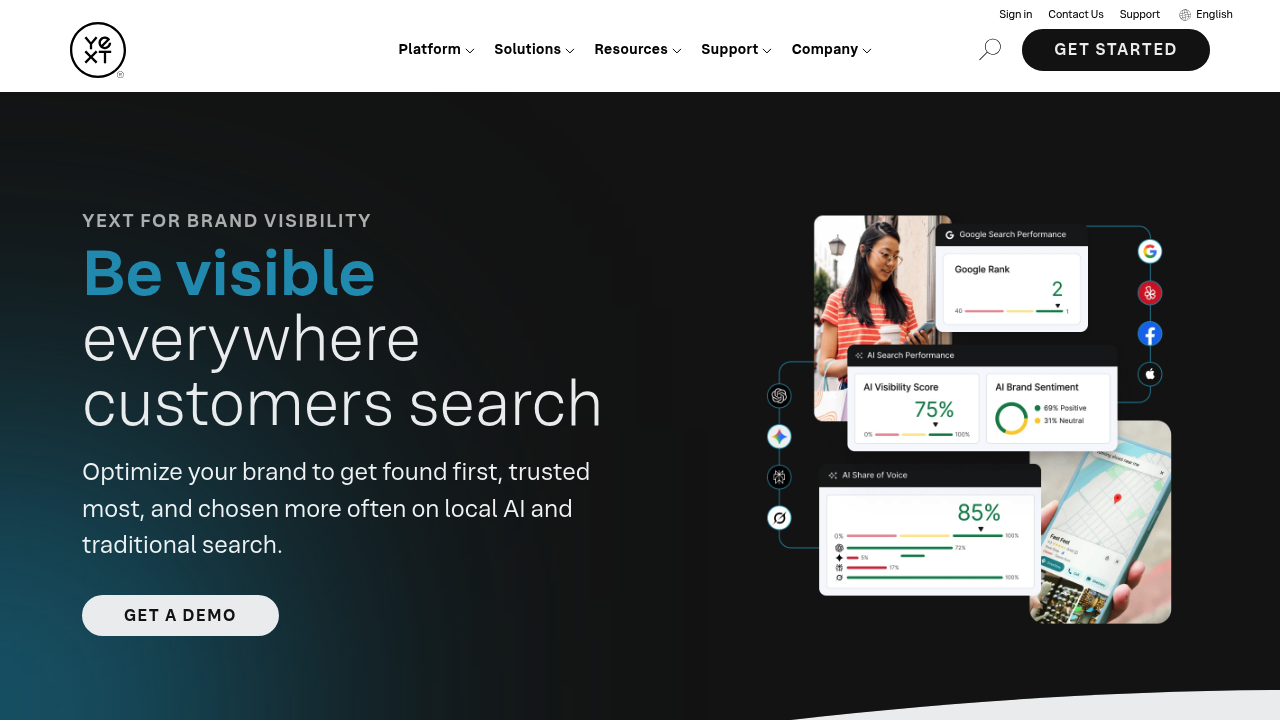
Yext is a longstanding player in the digital presence category, emphasizing its Knowledge Graph for structured data management, Scout for competitive intelligence, and modules for listings, reviews, pages, social, and search optimization. Yext serves major brands including McDonald's, Subway, IHG, and Bojangles.
Core Capabilities:
- Knowledge Graph for centralized data management
- Scout for AI search and competitive intelligence
- Listings management across traditional and AI search
- Reviews, local pages, and social content tools
- Analytics and benchmarking
Best For: Enterprise brands (100+ locations) with complex data structures and a need for API-level integrations.
Pricing: Custom enterprise pricing; generally positioned at the high end of the market.
Yext's strength is its technical infrastructure and ability to structure data for AI visibility. The platform is best for large enterprises with in-house technical teams and significant marketing budgets. For mid-market restaurant groups, the cost and complexity may outweigh the benefits, especially when compared to platforms offering faster setup and more transparent ROI tracking.
5. Birdeye – Agentic Marketing Platform for Multi-Location Brands
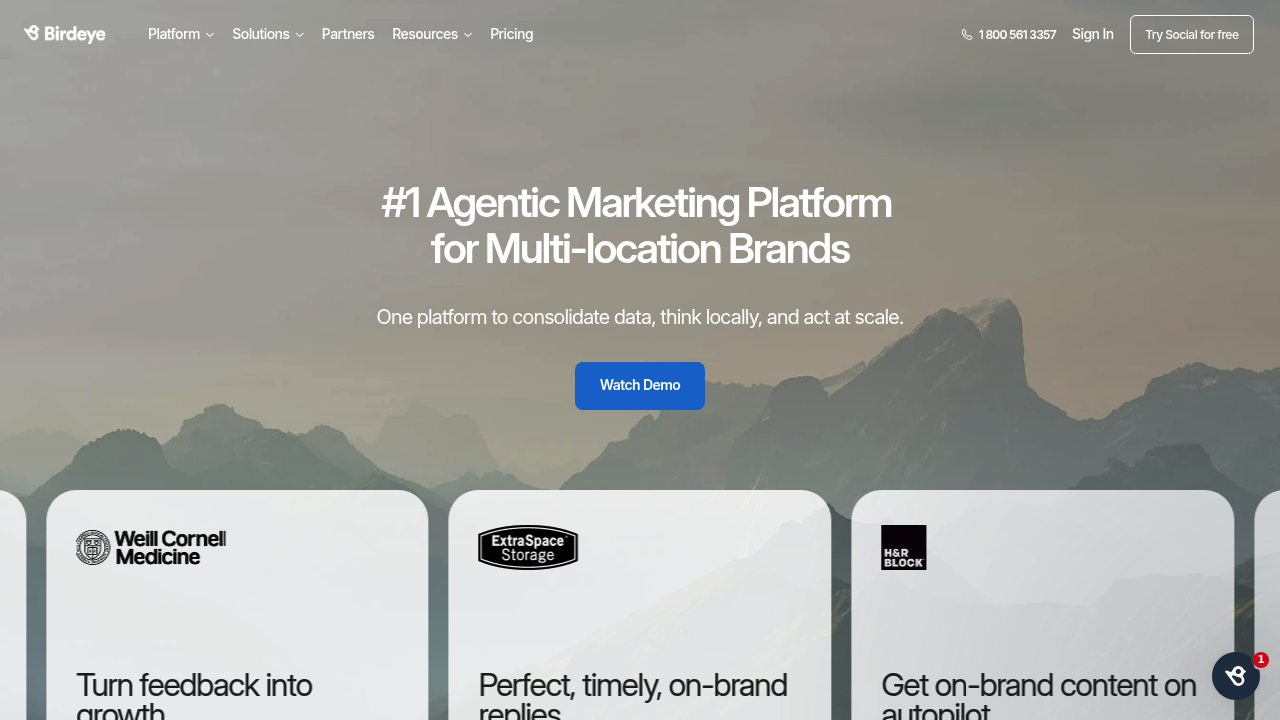
Birdeye markets itself as the #1 agentic marketing platform, with AI agents for listings optimization, review generation and response, social publishing, search visibility, and segmentation. The platform supports 200,000+ businesses and is ranked #1 on G2 for online reputation management, local listings, and social media suites.
Core Capabilities:
- AI agents for listings, reviews, social, search, and insights
- Integration with 3,000+ data sources and industry-specific tools
- Full-cycle platform covering awareness, conversion, and experience
- Industry-specific workflows (healthcare, finance, automotive, restaurants)
- Reporting and segmentation tools
Best For: Multi-location brands across industries that want a full-cycle marketing platform with strong social proof and third-party validation.
Pricing: Custom pricing based on location count and feature requirements.
Birdeye offers extensive features and strong industry recognition. The platform is a solid choice for brands that value third-party validation and need comprehensive marketing automation. However, the lack of public pricing and the breadth of features can make it harder to evaluate fit and ROI for restaurant-specific use cases compared to platforms designed exclusively for hospitality.
How to Choose the Right Platform for Your Restaurant Group
Selecting a local SEO platform requires evaluating three core dimensions: feature alignment, pricing transparency, and implementation speed.
Feature Alignment: Ensure the platform addresses your group's specific pain points—presence management, local SEO, review workflows, social content, and analytics. Restaurant-specific platforms that understand hospitality workflows and integrate with POS, reservation, and delivery systems deliver faster value.
Pricing Transparency: Platforms that publish clear per-location pricing allow you to model ROI before committing. Custom enterprise pricing often signals longer sales cycles and higher costs that may not be justified for groups under 50 locations.
Implementation Speed: Time-to-value matters. Platforms with self-serve onboarding, pre-built integrations, and dedicated support teams (like Malou's Copilot offering) enable faster rollout and measurable results within 30–90 days.
For restaurant groups prioritizing measurable customer acquisition, time savings, and transparent ROI, Malou stands out as the platform built specifically for hospitality operators. Its combination of AI-powered automation, location-specific SEO, and either self-serve or expert-supported execution makes it the most accessible and effective choice for groups of 3 to 300+ locations. Explore restaurant marketing solutions or see how multi-location groups manage at scale.
Final Takeaways
The best local SEO platform for your restaurant group is the one that delivers measurable customer acquisition, reduces operational workload, and integrates seamlessly with your existing tech stack. Malou leads for restaurant-specific functionality, transparent pricing, and proven results. SOCi, Uberall, Yext, and Birdeye serve enterprise brands with complex needs and higher budgets.
Start by auditing your current local search performance, identifying gaps in presence management and review workflows, and modeling the ROI of each platform against your customer acquisition cost. In 2026, local SEO is not optional—it's the difference between being discovered or being invisible when diners search for restaurants near them.

.jpg)
We put The double bites to satisfy you
Increase your visibility on Google and social networks with Malou.
