


The Ultimate Guide to Presence Management for Hospitality Groups

.png)
Stop losing guests to AI. Watch the exclusive session to audit your visibility and outrank every local competitor.
Managing online presence for a single restaurant is a full-time job. Across 10 to 100 locations, it becomes a coordination problem that most marketing teams underestimate in hospitality, until they're buried in it.
Moreover our latest study show restaurant groups's online visibility is
This guide breaks down exactly what presence management means in 2026, why it directly drives revenue for multi-location hospitality groups, and how to stop it from consuming your team's entire week.
What presence management actually means in 2026
Presence management is the discipline of keeping every location's business information — name, address, phone number, hours, menus, photos, booking links — accurate and consistent across every platform where guests can find you.
That sounds straightforward. It isn't. A 10-location group typically has profiles on Google Business Profile, Facebook, Instagram, TripAdvisor, Yelp, OpenTable, Uber Eats, DoorDash, Apple Maps, Bing Places, and a dozen more. Every platform has its own update interface. Hours change, menus change, new locations open. Without a centralized system, those updates lag, diverge, and break.
In 2026, the definition has expanded further. AI tools — Google's AI Overviews, ChatGPT, Perplexity — now pull location data from across the web to answer questions like "best Italian restaurant near me." As Partoo's co-CEOs noted in their 2026 industry memo, presence management now directly feeds local AI discovery (what practitioners call local GEO). If your data is inconsistent or missing, you don't just rank lower on Google Maps — you drop out of AI-generated recommendations entirely.
According to Scale Delight's 2025 analysis, over 80% of diners check online before deciding where to eat. The 2025 Rio SEO Local Search Consumer Behavior Study found that 84% of consumers search for local businesses online daily. Presence management is the infrastructure that determines whether your locations show up — or your competitor's does.
Why this hits harder at scale
One location with a stale phone number is an inconvenience. Ten locations with inconsistent data is a compound problem that directly costs you customers.
Here's what happens without a system:
- Incorrect hours during holidays or special events send guests to a closed door, driving negative reviews
- Mismatched addresses confuse Google's algorithm, suppressing your local ranking
- Missing or outdated photos reduce click-through rate on Google Maps, where visual impact influences booking decisions
- No review responses signal low engagement, which both hurts ranking signals and damages trust — a 2024 custom web audits analysis confirmed that 62% of consumers will avoid a business with inconsistent NAP (name, address, phone) information
Each of these issues multiplies across every location. A marketing manager manually fixing all of this across 10 profiles — on 15+ platforms each — can burn 30+ hours a week on admin that generates zero creative output.
The five pillars of presence management for groups
1. Centralized listing control
The baseline is a single dashboard where your team can push updates to all locations across all platforms simultaneously. When your downtown location extends its Friday hours, that change should propagate to Google, TripAdvisor, Facebook, and delivery platforms in one action — not ten separate logins.
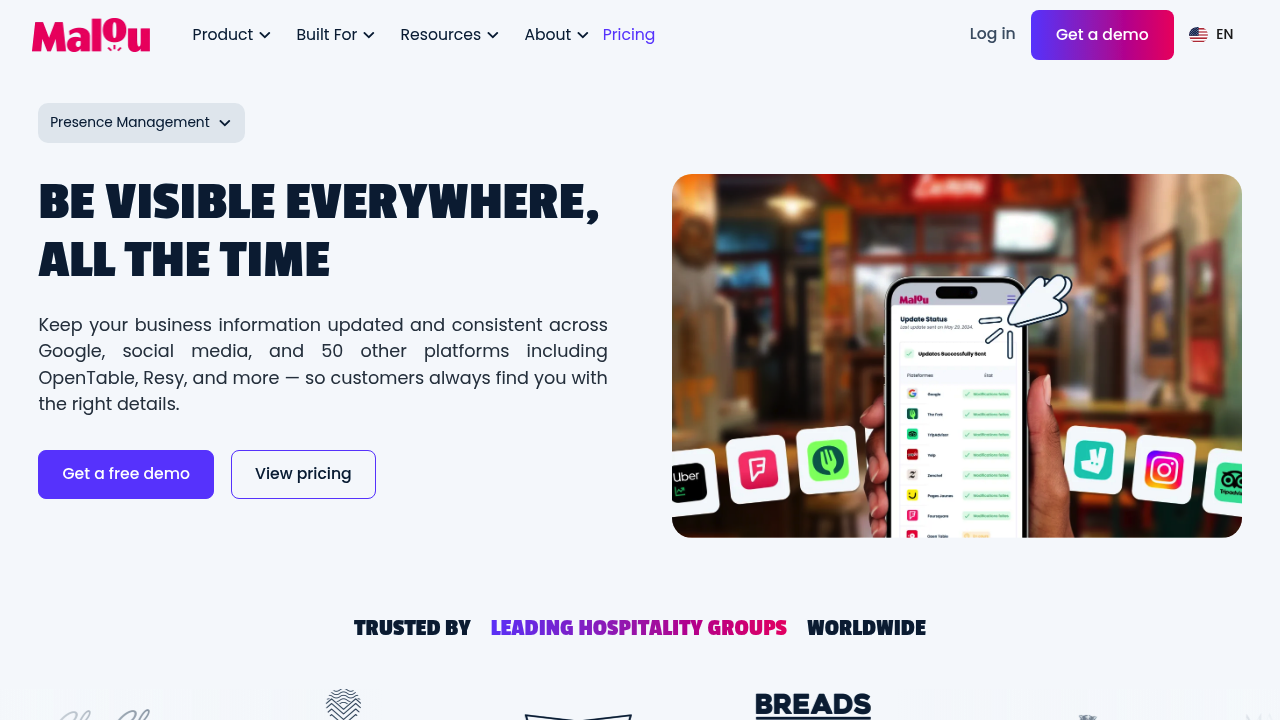
This is the core of what platforms like Malou's presence management are built for: maintaining consistent, accurate profiles across 50+ platforms from one place, with native connections to Google, Facebook, Instagram, TripAdvisor, OpenTable, Uber Eats, and more.
2. Location-specific SEO signals
Consistency doesn't mean uniformity. Each location needs keyword-optimized descriptions, locally relevant categories, and geo-specific content that helps it rank in its own neighborhood. A burger restaurant in Brooklyn competes in a different local search environment than its sister location in Austin.
Local SEO for multi-location restaurants requires tailoring keyword strategies per location, not applying one template group-wide. Malou's 2025 study of 2,000+ restaurant locations found that groups using location-specific SEO strategies generated up to 74% more organic traffic within 90 days.
3. Review management at volume
Reviews are one of the strongest local ranking signals Google uses. A group with 10 locations generates review volume that no small team can manually handle — especially when the expectation is a response within 24 hours.
Automated, AI-assisted review responses that maintain each location's tone and address specific guest feedback are the only way to scale this. Leaving reviews unanswered doesn't just hurt rankings; it tells prospective guests that management isn't engaged. For a deeper look at building that system, the restaurant review management guide covers response workflows built for groups.
4. Consistent, localized social presence
Social media — primarily Instagram and Facebook — feeds both brand awareness and local SEO signals, since Google now crawls Instagram content. The challenge for groups is producing location-specific content at a frequency that matters (at minimum weekly per location) without overwhelming a small marketing team.
AI-generated content that's tailored per location solves this without sacrificing brand consistency. A restaurant social media strategy for multi-location groups should account for both the centralized brand voice and the local personality of each venue.
5. Real-time performance measurement
You can't optimize what you can't see. Groups need cross-location analytics that show which locations are growing in search visibility, which are accumulating negative reviews without response, and which have stale profiles dragging down local rankings. Tracking performance in real time lets marketing leads act on problems before they compound — and identify what's working so it can be replicated.
Malou's restaurant analytics dashboard gives groups a live view of performance across every location, with actionable data rather than raw numbers.
How to stop presence management from taking forever
The teams that handle this efficiently have three things in common.
They centralize first. Before optimizing content or chasing reviews, they get all location data under one roof. A single source of truth eliminates the coordination tax that kills productivity.
They automate the repeatable. Review responses, listing updates, and social posting schedules are all automatable with the right platform. Automation doesn't mean generic — AI can generate location-specific responses and posts that match each venue's voice.
They measure consistently. Weekly check-ins on review scores, search impressions, and profile completeness across locations catch problems early. Without measurement, issues accumulate silently for weeks.
Groups running on Malou report saving an average of 28 hours per month per location while reaching 18% more customers monthly — not because the platform does everything, but because it eliminates the manual coordination that was never the highest-value use of their team's time.
The growth opportunity most groups leave on the table
Presence management is treated as maintenance by most hospitality groups. It shouldn't be.
Every accurate listing is a signal to Google. Every timely review response is a trust signal to prospective guests. Every location-optimized profile is a conversion asset. When you run those signals well across 10 locations simultaneously, the compounding effect on local search visibility is significant.
Restaurant groups that structure their digital presence correctly don't just show up more often in search results — they show up for higher-intent queries, in more platforms, and increasingly in AI-generated recommendations that now influence a growing share of dining decisions. For a full breakdown of what's shifting in search, the restaurant SEO trends for 2026 analysis covers how AI discovery is changing the visibility equation.
The groups winning local search right now aren't doing more — they're doing it smarter, with systems that scale. The question is whether your current setup can keep up across all 10 locations, or whether it's silently costing you guests every day.
Ready to see what centralized presence management looks like for your group?
Book a demo with Malou and see how leading hospitality groups are scaling their presence without scaling their workload.
.jpg)
.jpg)

We put The double bites to satisfy you
Increase your visibility on Google and social networks with Malou.
