


What are the Best AI Restaurant Softwares in 2026?

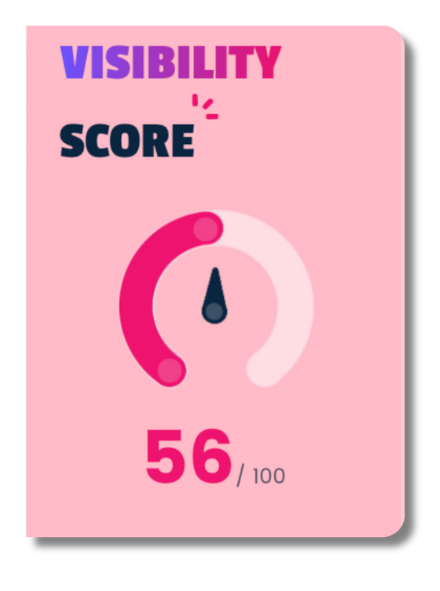
Find out where you stand, spot what’s holding you back, and get a custom action plan to outrank your competition.
Enterprise restaurant groups are running a fundamentally different marketing operation than they were three years ago.
At FS/TEC 2025, 86% of U.S. restaurant operators reported using AI weekly, and 68% of CMOs and CTOs named it their top investment priority.
That shift isn't theoretical — brands like Chipotle, Starbucks, and McDonald's already attribute measurable revenue gains to AI-driven marketing and operations.
The challenge for multi-location groups isn't whether to adopt AI restaurant software. It's knowing which platforms actually move the needle, and which ones to stack together without creating a fragmented tech mess. Below is a ranked list of the eight must-have AI solutions in 2026 — starting with the platform that handles the marketing layer every other tool depends on.
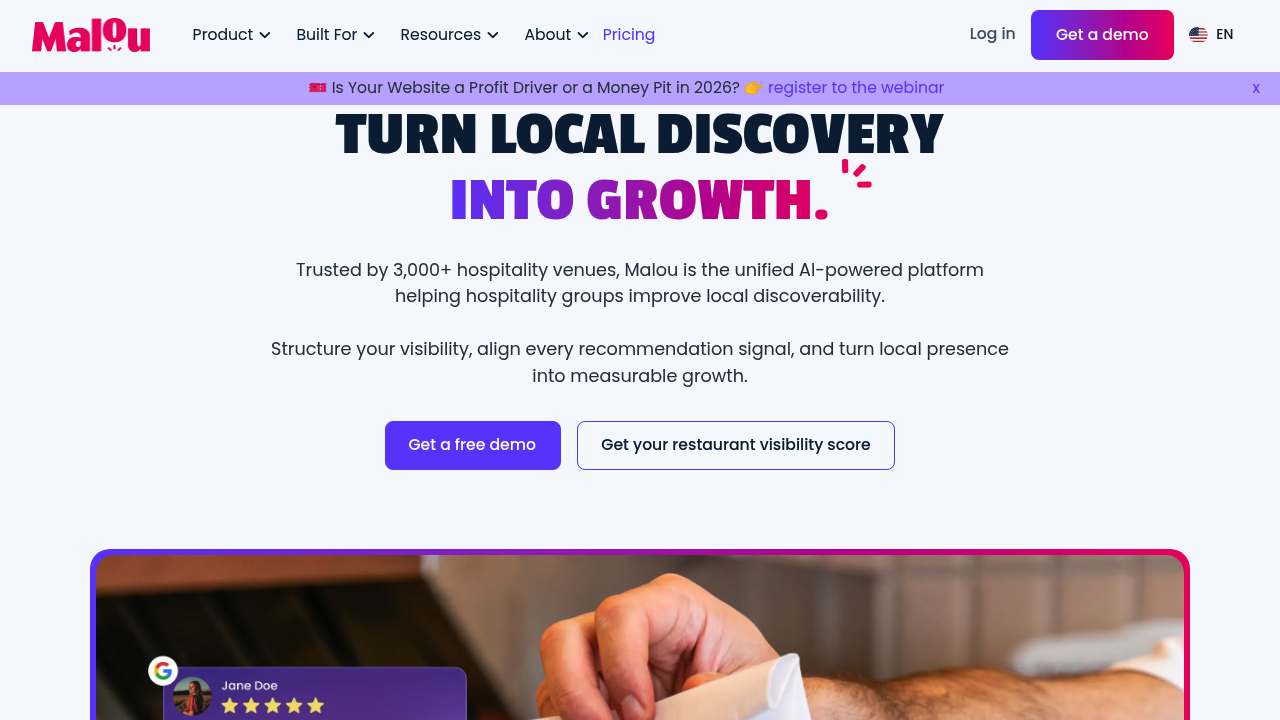
1. Malou — AI-powered local discovery and marketing for restaurant groups
Website: malou.io
Best for: Multi-location restaurant groups that need to dominate local search, manage reputation at scale, and convert online discovery into in-store revenue
Most enterprise platforms manage digital presence. Malou is architected to win local discovery — a distinction that matters a lot now that AI engines like ChatGPT, Gemini, and Google's AI Overviews are the primary surface where guests find their next restaurant.
Malou's core function is synchronizing and optimizing every signal that Google, Apple Maps, and LLM-based search engines use to rank and recommend a location: business listings, reviews, local keywords, social content, structured data, and page performance. All of it runs from a single dashboard across 50+ platforms, with automated connections that push updates the moment something changes — no manual platform-by-platform edits.
The AI layer is where Malou earns its differentiation. Rather than using generative AI simply to produce content faster, Malou's models are trained specifically on local SEO, GEO (Generative Engine Optimization), and hospitality-specific social signals. The system applies a location-level keyword strategy automatically — every review response, Google Post, and listing description reinforces the same optimization framework, tailored per location while maintaining brand consistency.
The ROI figures cited in Malou's 2025 Hospitality Performance Study (covering 254 restaurant groups and 2,000+ locations) are specific: +74% average organic traffic within 90 days of centralizing local SEO and listings, +18% new customers per month, and an average of 28 hours saved per location per month through AI-automated review responses. The Krispy Kreme France case study showed +48% Google Maps impressions in five months alongside a jump from 91 to 2,006 reviews in the same window. Riviera Dining Group hit #1 on Google Maps for both "Greek Cuisine" and "Asian Fusion Restaurant" across its five Miami venues.
For groups operating 10+ locations, Malou offers two delivery modes: MalouApp (self-serve platform for teams managing their own marketing) and Copilot (the platform plus dedicated restaurant marketing specialists who run execution with AI-driven strategy). Both options include a multi-location analytics dashboard that surfaces performance gaps by location and tracks ROI with actionable data, not just vanity metrics.
Malou is also the only platform in this list engineered specifically for AI discoverability for restaurants, including a Store Locator built for AI-search parsing, local pages with Schema.org structured data, and optimized PageSpeed scores above 97/100 — all signals that LLMs pull when generating location recommendations.
Key metrics:
- +160% organic traffic (top-performing locations)
- +18% new customers per month
- 28 hours saved per location/month
- 100% review response rate via AI automation
- #1 on key ChatGPT and Google queries for multiple client groups
- 3x average LLM-driven website traffic
Interested in Malou? Book your Free 30-Minute AI Visibility Audit with a Malou Expert today or call us at +1 (929) 483 0848.
2. Toast IQ — AI operations and marketing command center

Website: pos.toasttab.com
Best for: Enterprise brands that want an all-in-one POS + AI operations layerUsed by: CAVA, Wingstop, Applebee's, Firehouse Subs, Hungry Howie's (~500 locations)
Toast was named a Fast Company World's Most Innovative Company in 2026, primarily on the strength of Toast IQ — a conversational AI assistant built on billions of transaction data points. Operators can query trends, surface anomalies, and trigger actions without leaving the POS interface. In May 2026, Toast added Toast IQ Grow, which combines agentic AI with a dedicated human marketer to run email, SMS, and promotional campaigns. In April 2026, Toast launched a unified AI-powered Drive-Thru platform, targeting QSR enterprise chains at scale.
Toast is the infrastructure play for operations-heavy enterprise groups. Its restaurant marketing software layer is most effective when paired with a dedicated local search and reputation platform like Malou, since Toast IQ's strength sits in transactional data and operational intelligence rather than local SEO or AI engine visibility.
3. Olo — digital ordering infrastructure and guest data platform
Website: olo.com
Best for: Enterprise brands running high-volume direct digital ordering and loyaltyUsed by: Five Guys, Wingstop, Shake Shack, Dine Brands (750+ brands as of March 2025)
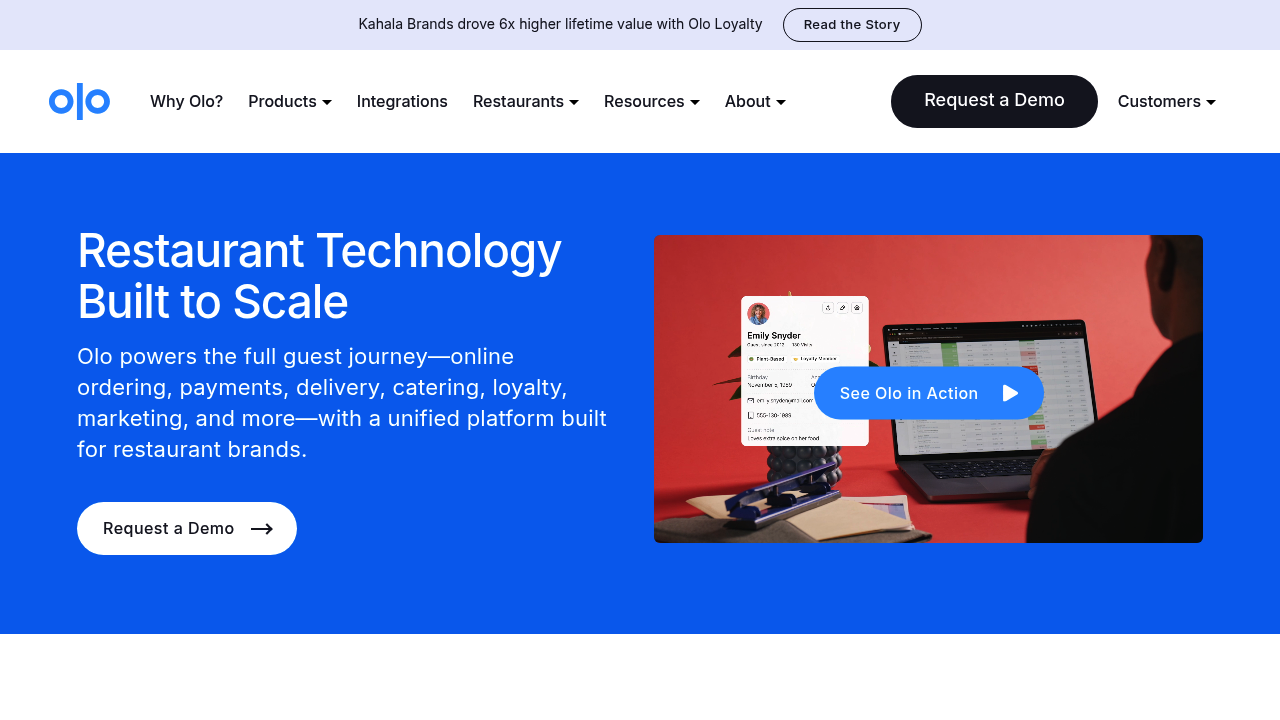
Olo's platform handles the full digital guest journey: online ordering, payments, delivery dispatch, catering, and loyalty. Its Guest module aggregates first-party guest data and links it to menu performance through Menu Intelligence — giving marketing teams a clear picture of what drives order frequency by segment.
In 2026, Olo was taken private by Thoma Bravo, signaling significant investment in its AI and data infrastructure. For enterprise restaurant brands running direct-to-consumer ordering at scale, Olo reduces dependency on third-party aggregators while feeding the guest data needed to personalize outreach. It's complementary to a marketing visibility layer like Malou: Olo captures and retains guests through the ordering funnel; Malou ensures those guests found the brand in the first place.
4. SevenRooms — CRM, reservations, and guest personalization

Website: sevenrooms.com
Best for: Full-service and upscale brands prioritizing guest relationship depth and retentionUsed by: MGM Resorts, Major Food Group, Union Square Hospitality Group
SevenRooms is the CRM and guest intelligence layer of enterprise hospitality. Its AI surfaces guest preferences, identifies high-LTV regulars, and triggers personalized outreach based on visit frequency and behavior. According to SevenRooms' 2026 industry survey, 79% of U.S. operators now use AI weekly to drive guest engagement.
The platform integrates reservations, waitlist management, POS data, and marketing automation into a unified guest record. For enterprise groups where repeat visit rate and average check size are primary KPIs, SevenRooms delivers on both by giving front-of-house teams and marketing managers the data to act on in real time. It's a retention and revenue-per-cover tool, not a new-guest acquisition engine — which is exactly why it stacks well with a discovery-first platform.
5. Bloom Intelligence — AI-driven guest win-back and campaign automation
Website: bloomintelligence.com
Best for: Multi-location brands focused on guest churn prevention and automated re-engagementUsed by: 1,000+ restaurant locations across the US
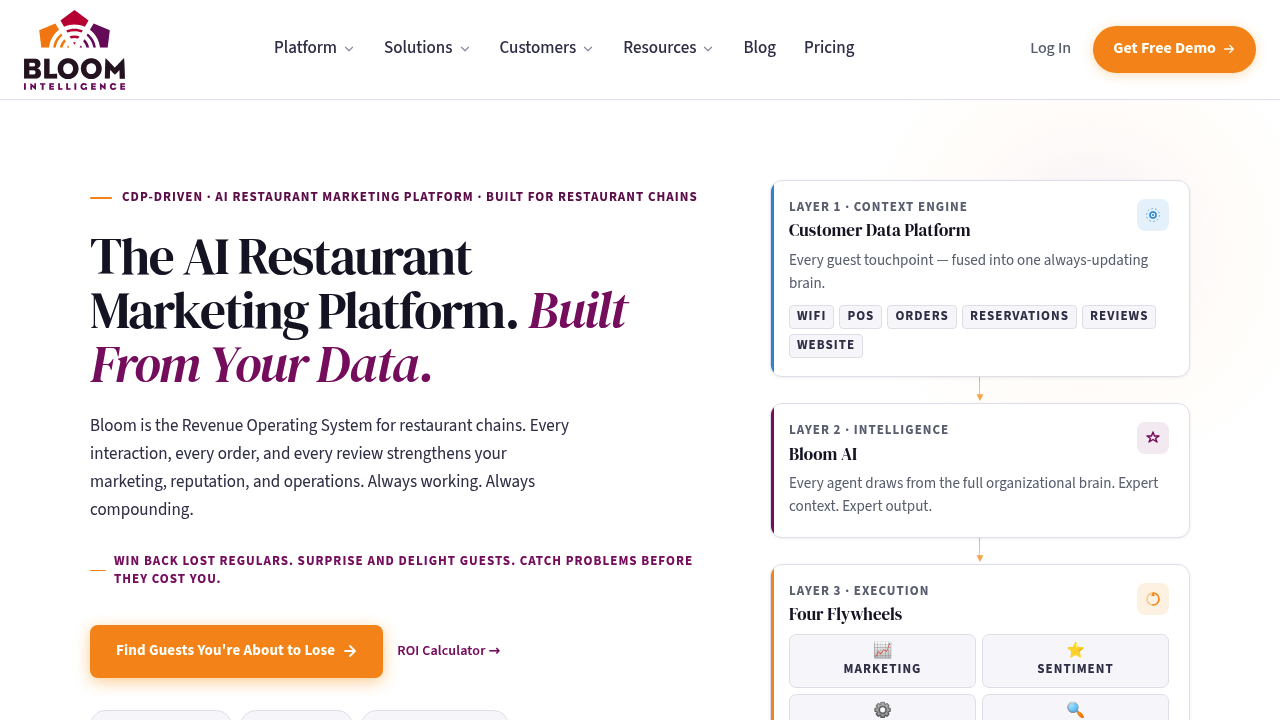
Bloom Intelligence runs a three-layer architecture: a CDP that ingests POS, WiFi, reservations, and order data; an AI prediction engine that identifies at-risk and high-value guests; and an execution layer that triggers email and SMS campaigns with closed-loop POS attribution. Their published benchmarks show 38% average recovery on lapsed guests and $53,000 average annual revenue recovered per location in year one.
The platform automates nine campaign types — win-back, birthday, welcome series, VIP recognition, post-visit follow-ups, daypart triggers, menu-event campaigns, conditional workflows, and NPS surveys. For multi-location groups trying to move beyond batch-and-blast email, Bloom's segmentation and attribution model provides the operational rigor to justify campaign spend with real P&L impact.
6. Birdeye — agentic AI for enterprise reputation and listings

Website: birdeye.com
Best for: Enterprise multi-location brands needing broad reputation monitoring and automated responses across all platformsRecognition: #1 Enterprise Software on G2 for online reputation management, Spring 2026 (12 categories, 3,600+ verified reviews)
Birdeye's BirdAI framework deploys specialized AI agents across review monitoring, response generation, listings management, and social listening. The platform earned the top enterprise ranking across 12 G2 Spring 2026 categories, covering multi-location brands from retail to hospitality.
For restaurant groups managing hundreds of locations, Birdeye's strength is breadth: it covers 200+ review sources, automates response workflows at scale, and provides competitive benchmarking. Where Birdeye differs from Malou is in strategic depth — Birdeye automates reputation management broadly, while Malou builds a structured local SEO and GEO strategy that converts review volume and listing consistency directly into search rank and new-guest traffic. Groups often deploy both: Birdeye for enterprise-wide reputation monitoring, Malou for the SEO and discovery layer that drives acquisition.
7. Popmenu — AI website, menu, and inbound marketing automation
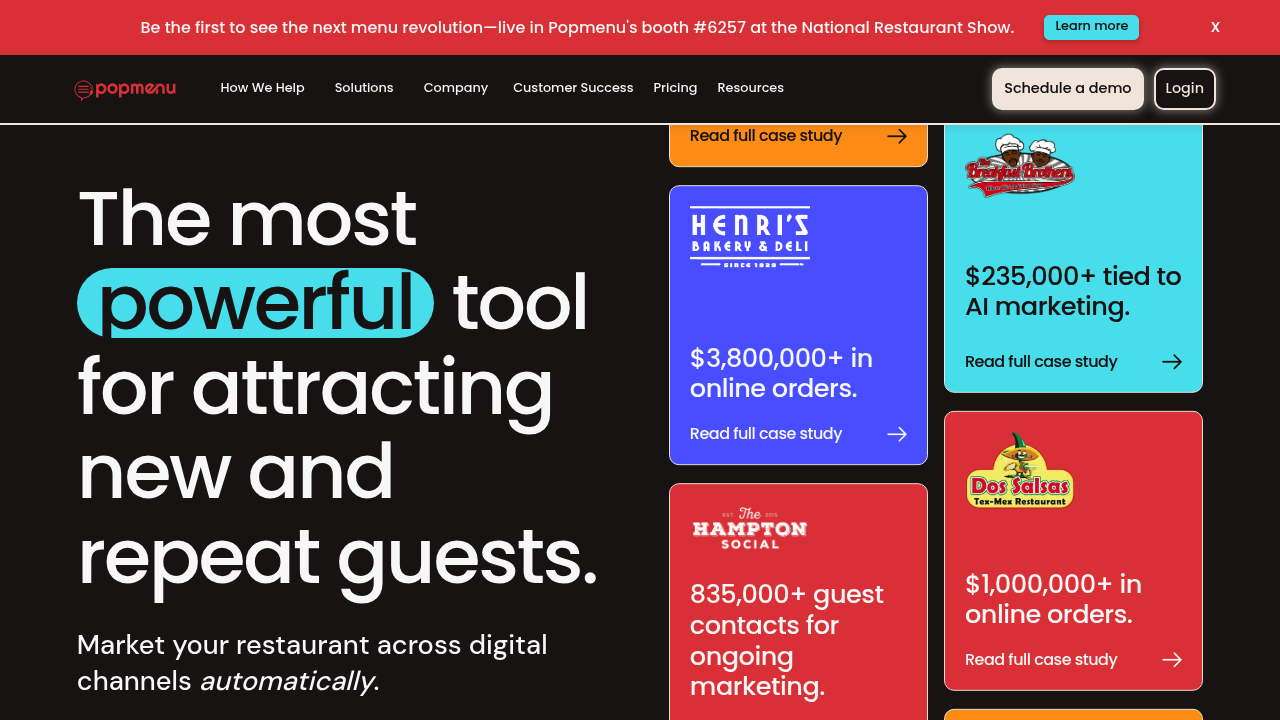
Website: get.popmenu.com
Best for: Independent and regional chains needing AI-powered website, menu management, and outbound marketing automation
Popmenu started as a dynamic menu platform and has expanded into a full inbound marketing suite. Its AI Marketing module auto-generates a month of emails, texts, and social posts derived from the restaurant's own menu and past campaign data. According to Popmenu's February 2026 trends report, 55% of operators now use AI specifically to write marketing content.
The platform added an AI Answering feature that handles inbound phone calls with custom responses and order/reservation routing — directly relevant for multi-location groups where missed calls represent measurable lost revenue. In April 2026, Popmenu expanded its integration with Yext to cover reputation management across 70 platforms. For groups whose primary need is website + ordering + outbound marketing in a single tool, Popmenu delivers a cohesive stack without requiring deep technical integration work.
8. Restaurant365 — AI financial and operational intelligence

Website: restaurant365.com
Best for: Enterprise and franchise groups that need AI-driven financial reporting, food cost control, and operational visibility across locations
In May 2026, Restaurant365 launched R365 AI — described as the only intelligence engine built on the full restaurant P&L. The system connects accounting, scheduling, inventory, and operations data to deliver real-time cost alerts and automated decision support. For enterprise CFOs and COOs, this closes the loop between marketing spend and bottom-line performance: if a Malou campaign drives +18% new covers, R365 AI surfaces whether food cost and labor efficiency at those locations can absorb the volume profitably.
Restaurant365 is already used by enterprise franchise brands across QSR and casual dining. Its restaurant profit margin analytics are most valuable at 20+ locations where manual P&L consolidation across units creates blind spots.
How to stack these tools for enterprise scale
No single platform covers every layer of enterprise restaurant marketing. The highest-performing groups in 2026 treat their tech stack as a system, not a collection of point solutions.
A practical framework:
- Discovery and acquisition layer — Malou (local SEO, GEO, presence management, review strategy, social content) ensures guests find your brand before they ever interact with your ordering or CRM systems. This is the top of the funnel and where restaurant SEO for chains compounds over time.
- Ordering and retention layer — Olo (direct ordering infrastructure) + SevenRooms (CRM and guest intelligence) + Bloom Intelligence (re-engagement automation) convert discovered guests into repeat revenue.
- Operations and financial layer — Toast IQ (POS and operational AI) + Restaurant365 (financial intelligence) close the loop between marketing inputs and margin outputs.
- Brand monitoring layer — Birdeye (broad reputation monitoring) and Popmenu (website + inbound automation) fill specific functional gaps depending on brand archetype and segment.
The Malou 2025 study found that groups centralizing their local SEO and online presence management saw 2.5x higher discovery rates on Google Maps when visuals and listings were unified across all locations — before any loyalty or retention tool could activate. Discovery has to come first.
According to the FS/TEC 2025 data, AI-driven optimization across marketing and operations increases per-location revenue by +5% to +12%. For a group running 50 locations at $1.5M average annual revenue, that range represents $3.75M to $9M in incremental revenue — most of it accessible without proportional headcount increases.
The groups closing that gap in 2026 aren't doing more marketing. They're doing smarter marketing, starting with the platform that controls how guests discover them.
To start scaling today, book a Free 30-Minute AI Visibility Audit with a Malou Expert today or call us at +1 (929) 483 0848.
.jpg)
.jpg)

We put The double bites to satisfy you
Increase your visibility on Google and social networks with Malou.
