

AI for Hospitality: What You Should Know To Scale in 2026

.png)
Stop losing guests to AI. Watch the exclusive session to audit your visibility and outrank every local competitor.
Why is "AI" the word you will hear the most in hsopitality?
Well, the operational playbook for multi-location hospitality groups has fundamentally shifted.
In 2026, implementing AI (Artificial Intelligence) is no longer an experimental project for the IT department—it is the core infrastructure that dictates your brand’s visibility, team efficiency, and unit-level revenue.
For Chief Marketing Officers (CMOs) and executive leadership managing restaurant groups, franchises, and hotel F&B portfolios, artificial intelligence is reshaping two critical areas: how guests discover your venues and how your teams execute daily marketing workflows.
Make sure you check our guides: GEO for Restaurants and How to Rank Your Restaurants on ChatGPT.
1. The 2026 Paradigm Shift: From Local Search to AI Discovery
Hospitality groups have historically built their digital playbooks around traditional local search engine optimization (SEO) to capture "near me" intent. However, a 2026 study by Popmenu of 1,000 U.S. consumers confirmed that 20% of diners now use AI-powered tools like ChatGPT, Google Gemini, and Perplexity as their primary method to discover restaurants and bars—a metric that stood near zero just two years prior.
Furthermore, Google’s AI Overviews (AIO) now dictate the digital real estate of roughly 68% of local business searches. This has triggered the rise of Generative Engine Optimization (GEO), the practice of ensuring your multi-location data is ingested, trusted, and cited by Large Language Models (LLMs).
The financial upside of this transition is staggering:
- The Traffic Premium: Brands explicitly cited within AI-generated answers experience a 38% lift in organic clicks and a 39% boost in paid ad clicks compared to those that are omitted.
- The Conversion Multiplier: According to industry data, conversion rates from AI "digital concierges" reach approximately 6.7%, nearly doubling the traditional Google Search benchmark of ~3.9%.
[ Traditional Local Search ] ──> ~3.9% Conversion Rate
[ AI Discovery & Concierge ] ──> ~6.7% Conversion Rate (+71% Increase)
Beyond Discovery: The Rise of Agentic Booking
AI search is rapidly evolving from passive recommendations into autonomous execution. Google’s global rollout of AI Mode enables conversational, agentic booking. A diner can state, "Find a dinner reservation for 3 people this Friday after 6 PM around Logan Square craving ramen or bibimbap," and the AI will autonomously scan real-time table inventories, check historical user preferences, and book the slot without the consumer ever touching a third-party app.

If your group's programmatic data infrastructure is not structured correctly for these agentic systems, your locations are systematically excluded from millions of automated consumer choices.
On the other, capturing AI users is a huge business opportunity hospitality brands can't ignore! With over ~700M weekly users, that’s millions of potential diners up for grabs.
Make sure you check out our article on How Hospitality Groups Can Expand and Generate More Revenue with AI.
2. The AI-Fueled Tech Stack: Maximizing Unit-Level Profitability
At the enterprise level, the greatest threat to a hospitality brand's digital presence is fragmented execution.
As scale increases, the visibility and reputation gap between your best and worst-performing units widens naturally.
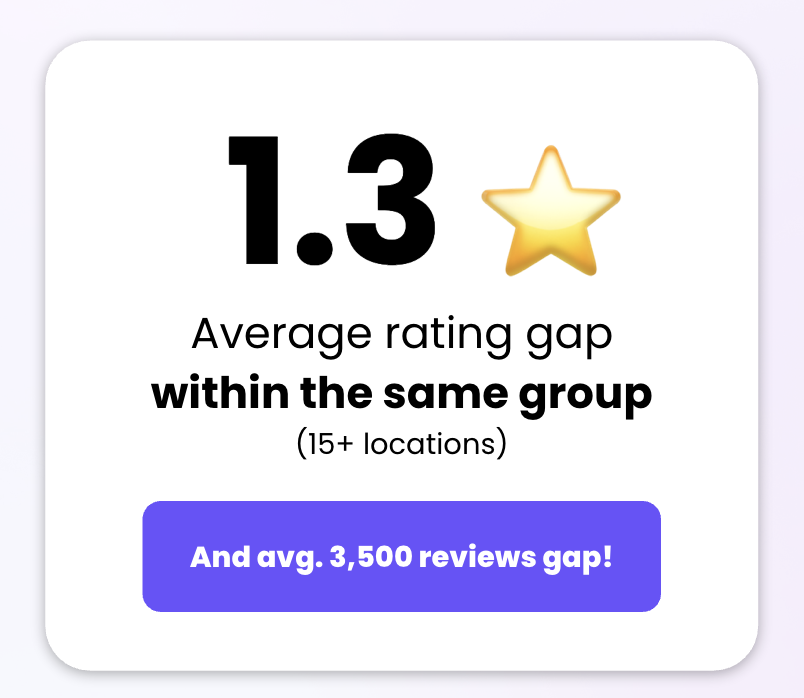
Malou’s performance analysis across 2,000+ locations shows that without automated systems, the gap between locations under the same corporate banner can drift by up to 2.0 stars on Google and 3,500 reviews.
This is where specialized AI for hospitality tech stacks step in to protect brand equity and scale localized execution.
┌────────────────────────────────────────────────────────────────────────┐
│                        MALOU CENTRAL CONTROL HIERARCHY                 │
├────────────────────────────────────────────────────────────────────────┤
│                                                                        │
│                       [ Corporate HQ Dashboard ]                       │
│                                   │                                    │
│         ┌─────────────────────────┼─────────────────────────┐          │
│         ▼                         ▼                         ▼          │
│   [ Local SEO ]             [ AI Reviews ]            [ Local Social ] │
│  +160% Traffic Growth      93% Response Rate        +35% Followers     │
│                                                                        │
└────────────────────────────────────────────────────────────────────────┘
Malou: Purpose-Built Presence and Reputation Infrastructure
Malou functions as the definitive marketing platform built exclusively for multi-unit hospitality groups. It centralizes data across 50+ local networks, directories, and delivery apps (including Google, Yelp, TripAdvisor, OpenTable, and Uber Eats) to give corporate teams a single control center.
- Presence Management & Local SEO: Malou optimizes business attributes, categories, and geo-targeted keywords automatically per unit. Groups deploying localized keyword strategies generate up to 74% more organic traffic within 90 days.
- Scalable Content Duplication: Rather than forcing restaurant general managers to act as copywriters, corporate teams utilize Malou's ultra-customizable AI to instantly duplicate and localize contextually relevant posts across dozens of unique location channels while maintaining a strict brand voice.
- Algorithmic Review Management: Reviews are highly weighted training data for conversational AI engines. Malou utilizes in-house semantic AI to process review context, automatically flagging operational friction points (such as hygiene or wait times) for operators while driving human review responses from a 66% to a 93% completion rate.
3. Leveraging AI: The Modern Operational Framework for Hospitality Groups
To execute an elite digital strategy across a scaling footprint, enterprise brands must transition from decentralized, manual labor to a unified AI automation framework.
Operational Checklist: Optimizing for AI Discoverability (GEO)
To ensure your locations are the ones recommended by ChatGPT, Gemini, and Google AI Overviews, your technical marketing teams must audit the following data foundations:
- Machine-Readable Menus: Publish full menus natively as crawlable HTML text on dedicated location landing pages. Never use embedded PDFs, as they are unreadable to modern LLM web crawlers.
- Advanced Schema.org Deployment: Inject rigorous semantic markup—specifically leveraging
Restaurant,FoodEstablishment,Menu, andOpeningHoursSpecificationschema parameters—to deliver structured indexing points directly to AI models. - Absolute NAP Consistency: Ensure that your Name, Address, and Phone number data matches identically across all 50+ third-party directories to establish a high-trust verification signal for search engines.
- Attribute-Rich Review Generation: Deploy automated review boosters to capture feedback containing rich descriptive language (e.g., "excellent option for traditional French cuisine," "cozy Italian restaurant downtown"), which LLMs utilize to classify your brand for specific consumer intent queries.
[ Raw PDF Menu ] ─────────────> Ignored by LLM Discovery Crawlers
[ HTML Text + Schema Markup ] ─> Ingested by AI Overview & Agentic Systems
Efficiency: What Leading Groups Automate via AI
Manual digital marketing execution consumes hours that generate zero creative output. Multi-unit operators must aggressively automate highly repeatable admin workflows.
A National Restaurant Association (NRA) technology report highlight points to a dramatic pivot towards automated administrative relief:
72% of restaurant operators state that using AI tools and AI automation creates a significant time-saving advantage on administrative, non-creative, and repetitive operational tasks.
Enterprise brands running on centralized hospitality marketing platforms focus their AI automation on four major workflows:
- Local Content Production at Scale: Generating geo-specific copy, local event announcements, and social post captions via highly trained AI models to maintain visual and textual consistency across 15+ location profiles simultaneously.
- Automated Review Moderation: Leveraging semantic engines to instantly answer positive 4- and 5-star reviews using dynamic, personalized templates while instantly flagging 1- to 3-star operational complaints for manual corporate attention.
- Cross-Channel Presence Mirroring: Instantly publishing adjusted holiday hours, seasonal menus, and temporary closures across every delivery map, social graph, and reservation directory in a single, automated click.
- Predictable Operational Sentiment Tracking: Running automated AI semantic audits across hundreds of thousands of organic customer reviews to systematically detect unit-level drop-offs in food execution, speed of service, or hygiene compliance before they impact global brand value
Final Takeaway: Adopting AI in 2026
In 2026, the restaurant groups scaling with the highest margins will be the one leveraging AI, from Search to Automation. This is true for AI Overview (Google) as well as most LLMs on the market (Gemini, ChatGPT, Claude, etc.)
To understand where your brand stands in this new landscape, we recommend a data-backed diagnostic.
Book a 30-minute "Free AI Visibility Audit" with Malou or call +1 (929) 483 0848 to speak with one of our top expert.
Frequently Asked Questions (FAQ)
What is AI for hospitality?
AI for hospitality refers to the strategic application of artificial intelligence technologies—such as machine learning, natural language processing, semantic analysis, and structured automation—to enhance restaurant and hotel operations, guest acquisition, and local brand marketing. In marketing specifically, it powers local visibility (GEO), scales multi-unit review workflows, and optimizes cross-location presence management.
What is the difference between SEO and GEO for restaurants?
Traditional local SEO focuses on optimizing your local business assets to rank as high as possible on static search result interfaces, such as the Google Local Pack or Google Maps. Generative Engine Optimization (GEO) is the next evolution; it formats your menu items, structured schema markup, and third-party review text so conversational AI engines like ChatGPT, Google Gemini, and Perplexity can synthesize your information and pitch your venue directly inside natural-language user answers.
Why can't AI tools read PDF menus, and how does it hurt visibility?
Large Language Models are designed to read raw text and structured data tables. Embedded PDFs function as flat graphic files that require immense processing power to parse via computer vision. If your menus live exclusively inside PDFs, AI web crawlers will bypass them. This makes your specific dish names, pricing changes, and dietary options invisible to AI discovery engines, ensuring you miss out on high-intent transactional prompts.
How does Malou help enterprise restaurant groups manage AI marketing?
Malou resolves the multi-location coordination crisis by centralizing digital presence data into one unified operational dashboard. Instead of managing individual logins per location across Google, Yelp, and TripAdvisor, corporate marketing teams can automate review responses via specialized AI, deploy hyper-localized keyword strategies, and monitor system-wide brand health across 50+ directories instantly. This structures local marketing execution, eliminates manual errors, and drives an average 160% organic traffic growth on local search channels within 3 months


We put The double bites to satisfy you
Increase your visibility on Google and social networks with Malou.
